
no problem!
you know how it is! you throw a snowball and there goes an avalanche....
-
-
... vibration that is otherwise absorbed by the stock rubber guibo. Vibration that WASN'T there prior to installing your product. Yet I'm the one speculating that your product deflects vibration to the drive train? You all but outright admitted it.
You are the only person speculating. Check the parts numbers ITS A FACT. You can speculate all you want about what "they might use it on" but the part you show is used in automatic 135i / 335i/ and 535i cars and RUBBER guibos are used in MANUAL 135i / 335i / and 535i cars and I don't doubt BMW engineers had a good reason to use 2 different parts on cars with different transmissions. BMW is very efficient at assembling cars and rarely uses different parts in their build process unless they feel its necessary.What you are saying here is speculation. You do not know that it was designed for an auto. You do not know what they will use the new part on. Nothing about this other than the fact that they use an aluminum frame guibo is actual fact. The rest is speculation.
WRONG. I replaced the ORIGINAL guibo on my 1989 325is this past summer that had gone bad due to bad u-joints. It was installed in 1988. That makes it roughly 23 years old. That's hard proof.Again, you are not BMW. This is again pure speculation.
And no, the rubber guibo will not last 20+ years. It is rubber, ozone destroys rubber over time. In 20 years the rubber would be dry rotted and falling apart.
I too believe I've done more than enough to make my point. I just ask that anyone who reads through this does the research themselves and makes an educated decision but I believe this post on your Bf.c thread pretty much sums it up.
Last edited by RobertK; 04-12-2012, 08:07 PM.Leave a comment:
-
We have spoke with the customer you are referring to multiple times on the phone. We have come to the conclusion that his u-joints are bad and they were bad prior to the installation of the flex disc. He agrees and is currently correcting the pre-existing issue.
The shimming instructions that you are referring to are at the bottom of our installation page and they are intended for the Cadillac guys who have drivelines that are setup a little different than BMW. They do not have the centering pin.
In some cases, a vibration may be present because the driveline needs to be properly phased. This condition is caused because every U-joint that operates at an angle creates a vibration. It creates that vibration because the U-joint cross rotates with the shaft in a circular motion while also moving from front to rear. That rocking back and forth motion as it rotates causes the cross in the U-joint to accelerate and decelerate. This creates what is called excitation torque. To cancel this excitation torque, the U-joint at the other end of the shaft needs to rotate at an equal but opposite angle in relation to the U-joint up front. By using U-joints in pairs and in phase, and the angle between the driveshaft and the equipment at both ends is the same, the acceleration/deceleration cycles tend to cancel each other.
On Cadillacs the transmission mount is very sloppy and has a tendency to sag severely. This is where the shimming comes in to raise the tail shaft which basically phases the driveline enough to cure the vibration.
What you are saying here is speculation. You do not know that it was designed for an auto. You do not know what they will use the new part on. Nothing about this other than the fact that they use an aluminum frame guibo is actual fact. The rest is speculation.
Pure speculation.
Again, you are not BMW. This is again pure speculation.
And no, the rubber guibo will not last 20+ years. It is rubber, ozone destroys rubber over time. In 20 years the rubber would be dry rotted and falling apart.
I feel that this thread is getting a little drawn out and I will refrain from posting now. I think both sides have said enough here. If anyone wants to discuss it further feel free to contact me via pm, email, phone, telegraph, or courier pigeon. :p
No hard feelings.Leave a comment:
-
You're taking that completely out of context and adding your own interpretation.. Just like the picture of the guibo for an AUTOMATIC transmission.This means that there is no axial difference between the transmission flange and the front part of the drive shaft. The flex disc does not and is not intended to make up for axial misalignments. The flex disc's sole purpose is to dampen rotational forces.
FACTS!
If what you claim were the case then please explain the vibration reported by your customer and your OWN INSTRUCTIONS to customers that they may need to realign their driveline to reduce vibration from the driveshaft?
You completely skated by the fact that you're trying to pass off a guibo designed for an AUTOMATIC transmission as a "good idea the BMW uses themselves" for a MANUAL transmission that BMW does NOT use on their cars with manual transmissions. Funny you do not acknowledge those "facts."
You're product deflects driveline vibration and shock absorbtion to the next weekest point in the driveline thus wearing out the very parts that the rubber guibo is intended to protect. $40 guibo vs. $350 driveshaft rebuild or worse.
BMW knew what they were doing when they designed these cars and the fact that the original stock guibo can outlast (20+ years) the u-joints in the drive shaft is proof of that.
FACTS!Last edited by RobertK; 04-12-2012, 12:57 PM.Leave a comment:
-
They do know a lot about BMW drivelines. Here are some interesting points from the page that you linked.
This means that the u-joints are what compensates for any drive shaft misalignment and that they are well capable of handling the load.The front half of a BMW driveshaft, (excepting early 1600's) is connected to the rear driveshaft with a universal joint and either a fixed or sliding spline. A universal joint is a precision bearing, which allows for small angle changes from engine/transmission movement. BMW driveshafts use an extremely precise design of universal joint with considerable torque carrying capacity for its size.
This means that there is no axial difference between the transmission flange and the front part of the drive shaft. The flex disc does not and is not intended to make up for axial misalignments. The flex disc's sole purpose is to dampen rotational forces.Another interesting feature of the most common BMW driveshaft design is that the front driveline is usually centered directly off the transmission main shaft. This driveline design causes BMW driveshafts to rotate with the smallest amount of radial run-out possible. Additionally the rear part of a BMW driveshaft is centered with the next most accurate means, a precision piloted fit flange.
FACTS!Leave a comment:
-
First of all that is a picture of an automatic transmission. Look up the part number for a 335i with a MANUAL transmission and you will see that it is a rubber flexdisc. BMW does not use this design on any of their cars with MANUAL transmissions.
Second look very close to that picture on the right hand side of that guibo and note the crack / stress damage to it.
Like it has been mentioned before, I would rather replace a $40 guibo than an entire drive train or even just the drive shaft for that matter.
This thread on Bf.c reaffirms that your product deflects drive line vibration elsewhere throughout the drive train.

i'd say these guys know a thing or two about BMW drive shafts.

Most BMW driveline designs use a rubber flex disc to connect the transmission to the drive line. This flex disc absorbs torsional vibrations from the engine/transmission and reduces shock load to the driveshaft and rear axle. The driveshaft is supported by a ball bearing, encased in a soft rubber cushion. This cushion also dampens unwanted driveshaft vibrations, and to some extent both the flex disc and the support cushion can be "tuned" to the specific arrangement of chassis, transmission and rear axle.Last edited by RobertK; 04-11-2012, 07:36 PM.Leave a comment:
-
Rubber bushings loaded into a aluminum frame. Similar idea to yours but poly and rubber are very different materials. FACT
I like your mount, you should find a press in rubber bushing with sleeve to work with your guibo and then you would have a perfect blend of adapter and guibo.
I like my rubber guibo, it takes all that abuse from my driveline. I would prefer to kill my $100 dollar guibo over my $1400 transmission or my driveshaft.
Do you have your guibos balanced after machining? I always wondered.Leave a comment:
-
Actually, today BMW uses a guibo that is very similar to the Revshift guibo on the 335i and some other cars.
Apparently, BMW doesn't think its a bad design/idea. Can't argue with that.
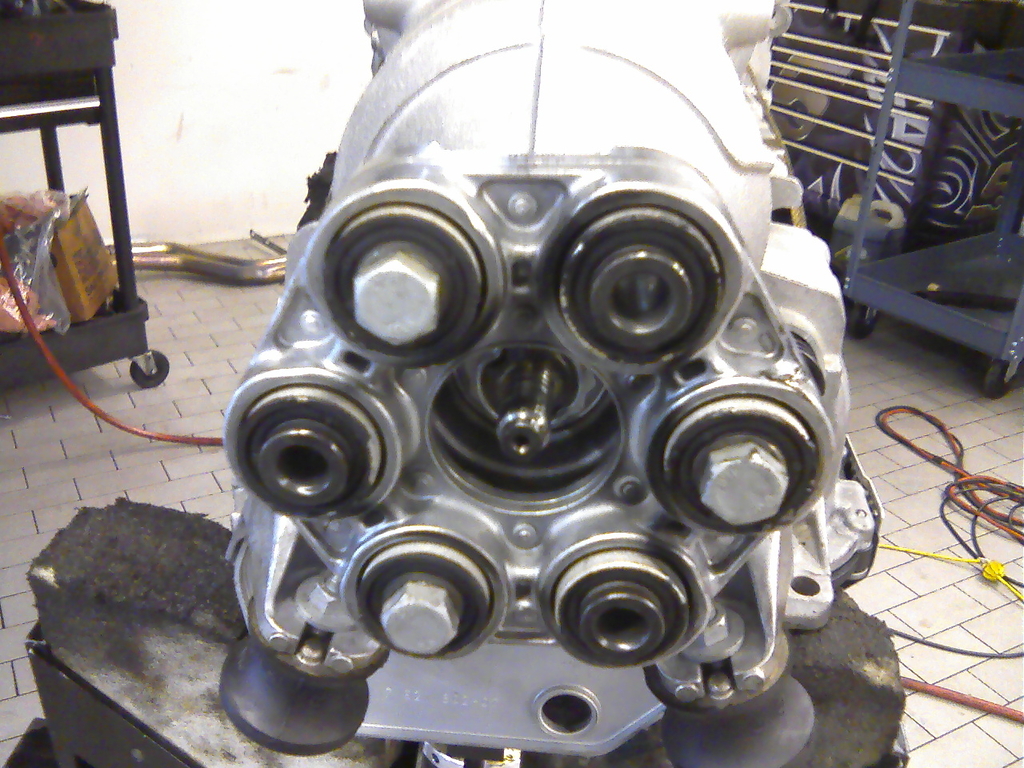
Our first test guibos that we made are currently on a couple daily driven e30's. They have been holding strong for over 2 years now. No broken drivetrain parts have been reported.
FYI, I will only post facts on the forums. I will not debate or participate in any discussion that strays away from the facts.Leave a comment:
-
agree bushings are ok to have stiff, guibo not so good. My center support bearing was shot for a long time and the guibo still didn't shread just cracked. if it was solid the u-joints would have been toasted.Leave a comment:
-
You're product hasn't been on the market long enough to prove anything and those uneducated about the issue will continue to blame bad center bearings or transmission mounts when they foul up. There is a comment on your website were a user says the rubber guibo is the weak point on a BMW when in fact 99% of the time the reason your guibo shreds because your u-joints have gone bad and the lock up kills the CSB and guibo.
The bushings might provide some cushion but the solid aluminum frame they are seated in does NOT provide an adequate amount of flex. Our cars are meant to being driven around curves not straight lines and to this day BMW continues to use rubber guibos for this purpose.Leave a comment:
-
I'm a BMW master tech and I wouldn't install a revshift Guibo in anybody's car. The OEM one is more than sufficient and it's not always required to remove all flex out of a car. I'll be using an OEM guibo in my turbo m52 in my e30 and I have no second thoughts about it.Leave a comment:


Leave a comment: