If this is your first visit, be sure to
check out the FAQ by clicking the
link above. You may have to register
before you can post: click the register link above to proceed. To start viewing messages,
select the forum that you want to visit from the selection below.
I work in commercial aviation, ( Boeing 777, 747s, Airbus 320-330-340 ) and all have in common the fact that the wires are ALWAYS crimped to terminals/pins/sockets.
the only solderings I saw are found in to internal components ( coockpit panels switches, computers ) which are always LRUs ( Line Replaceable Units ).
The main wiring on an airplane is there to stay and last long ( the whole aircraft life actually ).
A wire repair will always use a splices or terminals which are NEVER soldered, always crimped.
When aging aircrafts are undergoing heavy checks ( 1-2 month in a hangar ), they are stripped down, the wires in bad condition will be replaced, using the same method, never soldered, always crimped.
there will be only crimping on my E30 audio install, and the best way to do it properly is to invest ( cheap ) in a proper crimper.
I've used this type of splice a LOT as I am generally too lazy to carefully wrap wires and such and just don't need that strong of a connection. That being said, even using a lap splice, I have torn wires before the solder joint came apart pulling on them (I've also done this with crimped connections too though). Another reason I also use this splice over a wrap splice was brought up by bimmerteck; it usually makes a very large splice, plus it really is overkill in many applications.
But as I said before, I'm on the crimping side of this argument. Easier and plenty sufficient in my eyes.
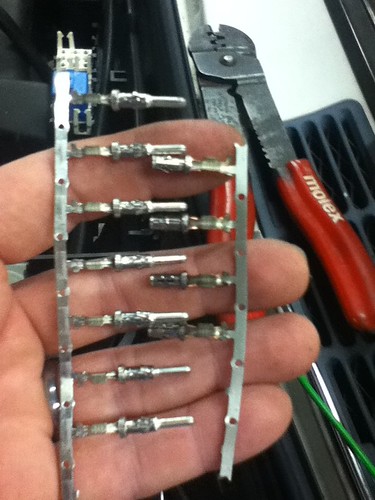
Where can one find those OEM style butt connectors besides the dealer? I have a handful of them but I'd like to buy them in bulk and would rather not get gouged by the dealer. What crimper is best for these butt connectors, the Molex one?
Also, does anyone know of a good pin removal tool for the C101 and X20 pins?
Those solder splices are pretty cool. I like how they incorporate a strain relief into it, as most cables I see fail not because of the crimp or solder connection, but because the vibration rattled the shit out of the stranded wire right behind the connection; there was no strain relief.
Yeah, that's kinda what I was getting at asking for failed connectors earlier, if there's no strain relief in the connection most failures will be a full on break at the stress point of the physical connection be it solder or crimp, hence nothing to test with the scope. :D
Originally posted by blueapplesoda
For uninsulated crimps, I found a great hand crimper made by Molex. Part number 63811-1000. Insulated crimps are trash to me. Digi-key has them for $35 or something, and it covers almost every wire size except for battery cables and large ground straps. Makes as perfect "B" type crimps as you can reliably do with your hand.
Molex makes great crimpers, mine have 35 years on them and still going strong.
Originally posted by blueapplesoda
I don't usually like to use butt connectors, and like Nando, I prefer to run a new strand of wire. But in the event I can't, I use these oem butt connectors (61138353746,61138353747,61138353748.) with normal olefin shrink tubing or adhesive lined shrink to provide a weather proof seal, depending on the environment, and as a strain relief.
One trick I use when using factory style butt crimps is to slide and extra section of heat shrink over the wire and leave it in the harness un-shrunk that way if somewhere down the line god forbid the circuit has an issue the tech can remove the original shrink wrap, inspect the crimp for contamination, and then reseal it with the spare piece of shrink wrap already on the wire.
Originally posted by blueapplesoda
I prefer crimps over solder, but that is because I am confident in my ability to crimp connections.
my 2c.
Derek
DedericMS
Appreciate it! I always like hearing how others do things in hopes of improving myself when someone someday tells me a better way! (it does happen I promise) The most important thing is that people use whatever gets them the best connection available to them with their skill set, knowledge, and tools at hand.
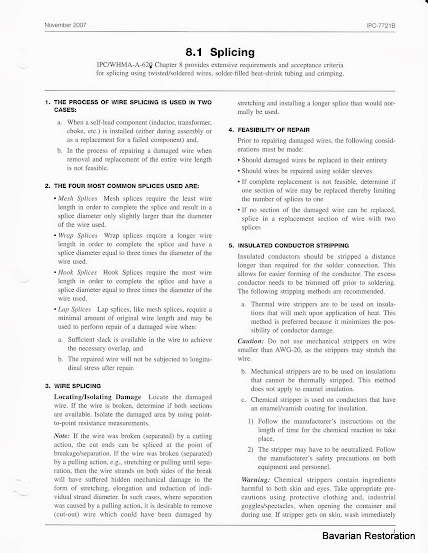
Here's some scans from training material that I've gone through.
I prefer to use Wrap Splice.
Thanks for the info, I always like seeing how other industries do things.
The wrap splice(or lineman's splice) is an excellent splice for single conductor wire where a physically solid low resistance connection is required. The resistance is lessend due to the high amount of physical contact between the wires induced by the twists, but in most automotive harnesses it is generally too bulky to be of use and can even introduce uneven resistance across multiple strands within the splice due to their place within the bundle.
It looks like your book had training on solder sleeves as well judging by the second bullet point under #4 on the first page. (though they may not allow it in your particular application)
Those solder splices are pretty cool. I like how they incorporate a strain relief into it, as most cables I see fail not because of the crimp or solder connection, but because the vibration rattled the shit out of the stranded wire right behind the connection; there was no strain relief.
I use to design and build wire harnesses (was a long term temp job a few years ago) for high vibration water filtration machines. I had no technical education or experience when it came to electricals and wiring, but just using the internet, a bit of logic and common sense, and inspection of what other electrical wiring mfg does on harsh enviroment/high vibration connections as my resources, I was able to get the job done well. I attempted to follow crimping procedures set in automotive standards (techniques and tests), and so far none of the machines have had any issues. I prefer crimps over solder, but that is because I am confident in my ability to crimp connections.
For uninsulated crimps, I found a great hand crimper made by Molex. Part number 63811-1000. Insulated crimps are trash to me. Digi-key has them for $35 or something, and it covers almost every wire size except for battery cables and large ground straps. Makes as perfect "B" type crimps as you can reliably do with your hand.
I don't usually like to use butt connectors, and like Nando, I prefer to run a new strand of wire. But in the event I can't, I use these oem butt connectors (61138353746,61138353747,61138353748.) with normal olefin shrink tubing or adhesive lined shrink to provide a weather proof seal, depending on the environment, and as a strain relief.
The only wires I've seen it damage,(on the back of a Jensen radio) would be damaged by any of the poly clear view heat shrink repairs and have no place being installed installed in my cars anyway.
I ONLY use clear poly heat shrink in cars b/c it allows for inspection for corrosion and moisture intrustion without dis-assembly, subsequent re-soldering, and re-shrinking.
They are also only heated by a jet of hot air, no open flames, no physical contact by a soldering iron.
That's a great link but I would only use those for wires with insulation rated to higher than 800 degrees. Many wires, including some auto wires, would melt the insulation around the splice.





Leave a comment: