-
Yep, equal amounts from both sides.
0.35mm each side.0.7mm extra metal - does this mean 0.35mm each side or one side only?
Thats not a small amount.....
So you believe, all things being equal (which I realize they aren't on these old diffs) that with an additional .35mm that they should still dis-engage? Is there a way to tell?For the giant turbo cars with massive tires and power I will sometimes give a little extra preload but not usually more than 0.05-0.15mm
The discs themselves should happily engage- and dis engage. if there is too much load than there will be excessive wear in parking lot situations
Since there is no rattle when I shake it, I'm inclined to think that the Bellevue springs are currently being pressed and the clutches are engaged.
So if I put the diff on and in a parking lot if feels like a solid axle, that means the clutches are being pressed hard, and never disengaging right?Leave a comment:
-
Did you make sure your center unit is still in the middle? I e remove equal material on each side to make sure its not shifted left or right?
0.7mm extra metal - does this mean 0.35mm each side or one side only?
Thats not a small amount.....
For the giant turbo cars with massive tires and power I will sometimes give a little extra preload but not usually more than 0.05-0.15mm
The discs themselves should happily engage- and dis engage. if there is too much load than there will be excessive wear in parking lot situations
Sent from my GT-N7100 using Tapatalk 2Leave a comment:
-
Progress update:
After the run around with one machine shop, I finally have the ramps back after a little grinding. They claimed to have taken 10/1000in off, (.25mm per side), which is pretty close to what my $30 gauge says. I also received my new 2.5mm clutches in the mail today, and confirmed that they are 2.5mm in thickness.
So, if the dog years that were in there were actually the 2.1, that means the final thickness over stock should be:
dog year x2 + clutch x2 - Grinding x2
(0.1mm + 0.1mm) + (0.5mm + 0.5mm) - (0.25mm + 0.25mm) = 0.7mm above stock
I've put the center portion all back together and was able to tighten the allen bolts down to spec (37ft lb), but I had to work really hard to do it. Each bolt had to be tightened about 1/4 turn all the way around the diff a dozen times before it was flat. If I pick it up and shake it, I get no rattle.
Is there any way at this point to verify that 0.7mm isn't too much? Or do I have to install it in a car and see if it all blows up on me?
Thanks for all your help, Wanganstyle! Hopefully there is a happy ending yet :)Leave a comment:
-
You are probably close enough that it wont really matter- the Bellevue springs will make up the slight variations in thickness.
You could also reduce static lock up and add an additional clutch plate and steel.
Are you measuring the outer edge or middle of the steels? Quite possible they are just original steels.
The really precise setups matter when the diff is setup without springs- zf units are spec ed spring less in alfa romeos as well as some bmw cars.
Sent from my GT-N7100 using Tapatalk 2Leave a comment:
-
Great info!
So shimming happens no matter what, even if only to realign things after many years of wear. Gotcha.
I've dropped the center ramps off at a machine shop to have them ground down. He's going to try and just take the surface clutch material off, but he's betting on having to take a little of the surface off. He thought minimum the surface would lose 5/1000-10/1000, which is .127-.254mm per side.
I'm looking at needing to add between 0.254mm-0.5mm + slack, assuming the internals have never been modified before. And that's the tricky part. See, the dog ears (steels?) I found in there are 2.11mm thick, which I believe means this thing has been refreshed once already, and who knows what they ground down or modified at that time.
I'm seeing two options here:- If I leave the two 2.1mm dog ears in there, and replace the spacer with a third 2.1 and a 2mm clutch, I should be up to 0.3mm over stock. That will be barely enough to overcome the grinding of the ramps assuming the minimum material is taken off. But I risk being stuck trying to figure out how best to add 0.2-0.5mm if things aren't tight. I'll also have invested 3 clutches and an additional steel at that point.
- What makes more sense to me is to not added a third clutch and steel, but find a thicker clutch. I see rumors of this mysterious thicker clutch, but I can't find a part numbers for it. Theoretically though if I could find a 2.1mm clutch, I'd be up to .4mm over stock with my only investment being 2 clutches. If I can find ones at 2.2 or 2.3, I'd be at 0.6 and 0.8mm respectively.
Without knowing what a stock ramp piece is measured at though, this is likely to be a tiny bit of trial and error. I measured my ramp pieces at 30.48 and 30.52 mm before the grind. Wanganstyle, do you know what they usually measure at? I'm mostly looking to figure out whether a previous owner ground these down when they put the porsche steels in.
Thanks!Leave a comment:
- If I leave the two 2.1mm dog ears in there, and replace the spacer with a third 2.1 and a 2mm clutch, I should be up to 0.3mm over stock. That will be barely enough to overcome the grinding of the ramps assuming the minimum material is taken off. But I risk being stuck trying to figure out how best to add 0.2-0.5mm if things aren't tight. I'll also have invested 3 clutches and an additional steel at that point.
-
***?
Used diffs cost used for a reason: the internal parts alone for rebuild add up like a bottom end engine rebuild. Unfortunate but true :(
******
reset of the ring and pinion is required even if the 4.10 ring and pinion stay with the 4.10 case, and only the internal clutch assembly is swapped out? How is that different than just adding/removing spacers, steels, and clutches? Or does that require a reset of the ring and pinion as well?
*****
Each differential center unit is slightly different in its manufacturing tolerances.
Bmw shim variation in range is very narrow for these units: cusrom grinding shims is not that uncommon procedure to get to perfect setting of gear relationship.
*****
Maybe if I get into an application where I need reliability (Racing, or DD) but right now it's a weekend car and track rat. Anything happens to it and I call AAA, and then swap back in the 3.73.
Track rats eat up the oem differentials quickly- a z3 torsen gear type unit would be a great choice if on a low budget and desiring a compromise setting more ideal for street. These dont wear out and can handle bursts at 1, 000rwhp proven.
***
Is "center ramps" the name for the entire piece that I show melted material on in my image? Or is it just the name for the one half of it?
Yes 2 center ramp pieces often collect melted on material from clutch discs.
**
What piece would the "top cap" be?
Top cap is bolted to capsule with allen head bolts and holds a bearing.
***
The clutch side of the center ramps piece has no scarring on it that I can feel, just that raised portion. What's under the raised portion I do not know. I guess I'll take it down do a machine shop and see if they can remove the material, and to take careful measurements if they end up taking any amount of original material off. I should be able to compensate with an additional steel/dogear, yes?
****
Just make sure the spider gear cluster stays centered when making any adjustments to the center stack
The clutch discs can be ordered in different thicknesses as well as steels customized
***
Thanks for the information. I realize you're a professional rebuilder here, and I'm just a guy that can't justify a professional rebuild at this point in time. So I appreciate you chatting with the DIYer inside me
**
I love sharing information: I exposed two machining methods of adapting a e36/e30 diff to e46/e39 non m on e46 fanatics and bimmerforms if you really want super diy insight
Sent from my GT-N7100 using Tapatalk 2Leave a comment:
-
While I agree with that philosophy in most cases, "new" diffs are a damned bit more expensive than used ones. I wouldn't need it to last long to recoup some of the money I spent on it. I do enjoy learning and doing some of this stuff myself, too :)
reset of the ring and pinion is required even if the 4.10 ring and pinion stay with the 4.10 case, and only the internal clutch assembly is swapped out? How is that different than just adding/removing spacers, steels, and clutches? Or does that require a reset of the ring and pinion as well?Swapping one center unit with another will require proper reset of ring and pinion; might as well have the entire unit hot tanked and all bearings/seals replaced at the same time before its setup by one with experience.
Maybe if I get into an application where I need reliability (Racing, or DD) but right now it's a weekend car and track rat. Anything happens to it and I call AAA, and then swap back in the 3.73.Do you wish for it to be rebuilt by one with experience and proper machinery/parts setup to refresh it?
Is "center ramps" the name for the entire piece that I show melted material on in my image? Or is it just the name for the one half of it?I often use porsche 2.4mm clutch discs and custom grind new steels to fit center ramps that have been precision ground.
Top cap should also be precision ground to be flat and spec'ed to suit configuration.
What piece would the "top cap" be?
The clutch side of the center ramps piece has no scarring on it that I can feel, just that raised portion. What's under the raised portion I do not know. I guess I'll take it down do a machine shop and see if they can remove the material, and to take careful measurements if they end up taking any amount of original material off. I should be able to compensate with an additional steel/dogear, yes?
Thanks for the information. I realize you're a professional rebuilder here, and I'm just a guy that can't justify a professional rebuild at this point in time. So I appreciate you chatting with the DIYer inside me :up:Leave a comment:
-
Severe aggressive use or running it with low fluid volume will create this kind of carnage.
If you tear down any e30 diff you may find similar melting of clutch materials to steels and sometimes center ramps- most of the units I tear down for customer rebuilds have destroyed internals of various degrees- dont waste your time replacing destroyed parts with almost destroyed items. Swapping one center unit with another will require proper reset of ring and pinion; might as well have the entire unit hot tanked and all bearings/seals replaced at the same time before its setup by one with experience.
Do you wish for it to be rebuilt by one with experience and proper machinery/parts setup to refresh it?
I often use porsche 2.4mm clutch discs and custom grind new steels to fit center ramps that have been precision ground.
Top cap should also be precision ground to be flat and spec'ed to suit configuration.
Sent from my GT-N7100 using Tapatalk 2Attached FilesLeave a comment:
-
-
Thanks for the information. Could you verify some information for me?
- If I were to transplant parts from the 3.73, I would keep the ring and pinon gears, and insert the new clutch carrier and all related internals. This means that the only damage that could have been done to the 4.10 would be against the largest and most solid gear sets in the diff, right?
- If I did it that way there would be no shimming or resetting, as no bearings would be touched, and all "matched wear items" are still matched together.
I've cleaned everything up and can see no visible marks or damage to any other internet parts. I realize that metal can be "damaged" in ways that aren't visual, but this gives me some hope. I'm going to guess that the softer clutch material just bounced around not causing any damage. The clutch disc and surface however got a piece stuck between them, causing an increase in heat that help melt/weld the clutch material onto the mating surface.
It seems that another route would be to just have the surface ground down 1mm on both sides, and have a 3rd dog ear (2mm) tossed in. That of course assumes that the machine shop can grind it accurately to within a tenth of a millimeter.
I almost wish I could say I did the damage to it, because that would mean I wouldn't have been ripped off when I purchased it :(I can tell you that the damage was from use by someone that mistakenly thought a BMW was a dragster. The hard launches stripped the teeth off clutches.Leave a comment:
-
I can't tell how deep the galling on the friction surface is. It could be ground off, but without thicker clutch disks I'd expect less lock. The other issue would be what those loose pieces of metal might have done to other parts of the differential. And if you swap parts from another differential you have to go through the full setup and shimming drill, which a a fair bit of work. In this case with an unknown outcome. I think I'd class this differential as recycle material.
I can tell you that the damage was from use by someone that mistakenly thought a BMW was a dragster. The hard launches stripped the teeth off clutches.Leave a comment:
-
i think a machine shop could easily machine that flat, try reassembling then testing lock up w a torque wrench?Leave a comment:
-
Damaged Diff, Recoverable? [Pics]
So I'm in the midst of "refreshing" a 4.10 LSD. I disassembled the entire thing only to find bits of metal everywhere, mostly inside the... LSD portion of the diff. I believe the bits of metal are what used to be teeth on the clutch discs.
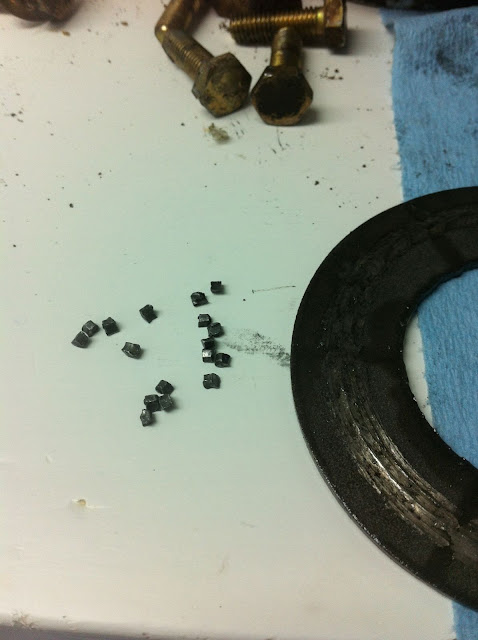
And here is what one of the clutches looks like. The other looks very similar.

There appears to be damage to the dog ears, but I had intended on replacing them anyway. What worries me is what the surface of the other surface looks like. It doesn't appear to be gouged, but it does appear to have had metal melted onto it. I can't describe it any other way.


It is certainly raised, but appears to be a part of the surface now. Attempts at scraping it off with a metal paint scraper have failed.
Has anyone seen damage like this before? I'm wondering if I took this to a machine shop whether they could remove what I hope is just clutch material from the surface. I realize that the thickness of this thing down to the tenth of a millimeter is important, so the actual surface can't probably be planed down at all. Or perhaps this thing is toast, and with it the diff since I don't think this is a replaceable part?
I do have a 3.73 LSD in the car that I was hoping to swap out and pass on to the community. However, I could rip it apart as well and pull these parts out of it, and between the two of them have one good diff. Seems like a waste though.
Higher quality images in the album here.
What does the R3V community think?


Leave a comment: