
Thanks very much!
Every single component of the UUC brake kit is proudly Made In USA.
- Rob
-
I didn't read anything in this thread but support our USA vendors!!Leave a comment:
-
Didn't we go through this a year ago? A bunch of off-base and information-free claims against our products? My friend, I'll answer any and all legitimate questions about our products, but you're really slinging mud without any basis.
And dumping all over a new product release? We must really be making an awesome product by your reaction! Thanks for the attention!
Lee, you're really gasping at straws here. Are you actually trying to make the argument that a caliper has some inherent deficiency if powdercoated?
Really?
Considering the fact that we're a direct distributor for PFC and Alcon (and we have custom calipers made to our specifications, with input from their factory engineers), I think we're a bit more connected with brake component development and manufacturing.
The fact that our own caliper was designed with employed engineering talent actually from two of the biggest race brake caliper manufacturers is also something you should be aware of.
No, they're primarily anodized or plated for corrosion resistance. Bare aluminum oxidizes, becoming dusty white. There's also the cosmetic component, of course, and the fact that it's cheaper than powdercoating. Not better - cheaper.
I can't say much about the Brembo calipers, I don't have their engineers on my cellphone speed dial as I do with PFC, Alcon, and Wilwood.
So I'll say what I can about those brands.
Performance Friction (PFC) calipers designed for race use, powdercoated by PFC:

And here's another one (mounted on a pro race car) powdercoated by PFC in black:

Alcon Mono6 calipers designed for race use, powdercoated by Alcon:
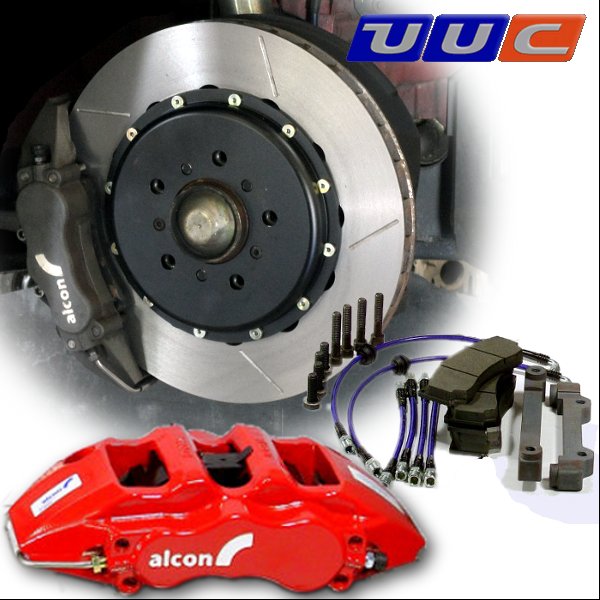
Alcon 4-piston calipers designed for race use, powdercoated by Alcon:
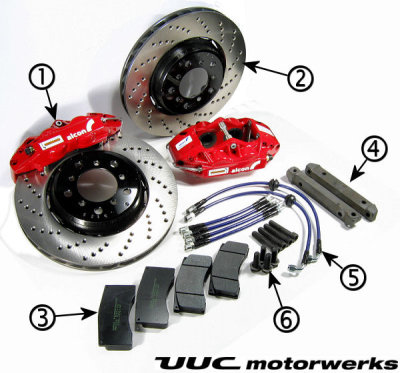
We put a lot of these JP, IP, GTS3, and MOD racecars.
"Crust"? Try a .5mm - 1.2mm thick layer. Far from "crusty".
Back to the idea of you splitting hairs here, we're talking about data that one could generate if one really tried to show an insulative characteristic of powdercoat... but I defy you to show any actual difference in real-world use, street or competition, regarding a thermal influence of powdercoat.
Yes, because they're not using powdercoat like serious race calipers. Those are their cheapie calipers, about $125 replacement cost at the dealer. There's a strong reason to suspect those calipers are actually using a very good paint, not powdercoat. I can't guarantee that, but other engineers have mentioned that to me.
Regardless, we've got enough years of experience with our own powdercoating, that of PFC and Alcon, to see that the color doesn't change.
But if you're comparing it to an anodized black caliper... I hope you warn your customers not to use any strong wheel cleaners that strip off andodizing. That never happens with powdercoat.
... state or powdercoated? Where's the rest of that quote?
The website states one of the finish options... it's not the only option.
Or were you trying to confuse the issue with that half-quote?
Yep, that's another coating... as Brembo says, to avoid corrosion. Nothing about thermal insulation.
Yep, it's an option. Same PFC kits they sell are also powdercoated.
Absolutely.
Let's review our new offering:
Finish: durable powdercoat that is chip-resistant, won't discolor, and has no legitimate effect on thermal insulation.
Piston count: Well, if you're a BMW CCA racer - you're rules-limited to 4 pistons. As any brake designer knows, once you've got a fixed caliper, more pistons does not help. Brake torque (and more accurately - correct brake torque, not the ridiculous 1.62" or 1.75" pistons use in absurdly front-biased kits) is about correct piston choice. Ideally, staggered pistons (such as the UUC caliper has) are better to equalize pad wear, minimizing taper.
Pad retaining system: structural bridge bolt, augmented by stainless steel anti-rattle clips.
Pad thickness: .480" / 12.19mm chosen to minimize caliper body thickness to maximize wheel clearance. More frequent pad changes are offset by costing approximately 50% of thicker pads. Racers using thicker pads typically change pads at less than full wear as heat cycling of the pads decreases their effectiveness long before they are physically worn down.
Pad shape: The 7212 pad is a standardized race pad, available from many pad manufacturers with many retail outlets.
Caliper manfacturer: UUC, Alpharetta GA.
Durability and intended use: stainless steel pistons, high-temp internal seals and 2-piece rotor proven in race use for many years. How can a brand-new product have many years of testing on these parts? Simple; these subcomponents are genuine Wilwood (seals) or original manufacturer (pistons) with a proven race history. The rotors and hats themselves are the same units we've been using with our previous Wilwood-based kits for years, again with a proven race history. The caliper body itself has been CAD-designed and FEA-analyzed to exceed the strength characteristics of the higher-end DyaPro caliper and Forged Superlite caliper.
This product is an evolution of the most durable proven parts and an all-new body design built to exceed previous offerings.
- Rob Levinson
UUCLeave a comment:
-
Competition calipers are anodized or plated to better evacuate heat. Performance Friction calipers are anodized, Brembo GTR calipers are anodized or plated (the regular GT are street application and of garden variety). Alcon Mono6 are anodized. And wether it is oil paint or plastic powder coat, it still is a thick crust over aluminum, and it still traps heat. Not to mention it will discolore if reaching high temps. We all know what happens to the Brembos on Mitsubishi Evos and Subis at track days... They turn to a muddy brown color.
From Alcon's website
"As for performance, Alcon has also addressed the important aspect of aesthetics with the Mono6. The hard anodised caliper body may be left in its normal ..."
Brembo website
"The finish on the GT-R calipers is nickel plating to avoid corrosion."
According to Bimmerworld
"The 4-piston Z31 caliper used in the front on this E46 kit is a Monobloc design... Calipers are finished with a black anodized surface."


Indeed every detail counts in a caliper. Surely, finish counts, but also the number of piston sizes/configurations available. How the pads are retained in the caliper. Pad compound thickness (8.5mm vs 16mm for a 7420 - Superlite clamper). Pad area. Which company is the manufacturer. Data in claims when it comes to stiffness. And especially to what type of duty the kit is designed for.
Nonetheless, beyond blanket statements extensively using the word "better" as a comparative mean, it would be proper to add to what it is compared, otherwise it could be misleading. Sometimes, the word "improved" is more adequate, as it most likely refers to a previous version of the same kit. ;-)Leave a comment:
-
Lee... seriously, you've got to be kidding. You posted that?
Besides, we use powdercoating, not paint. Just like Performance Friction, Alcon, Brembo... you know, those companies that you must think are apparently just basement hobby amateurs in the brake business and, by your comment, clearly know very little about performance brakes. LOL!
But hey, if an enthusiast wants us to supply a bare aluminum caliper (which you must think clearly more heat-dissipative than all that insulating anodizing!), we can do that too. That's the freedom of being a manufacturer, infinite customization.
- RobLeave a comment:
-
I really don't know where to start. Maybe tomorrow. Good night everyone.
BTW - Paint on calipers traps heat and melts from brake fluid. Race calipers are anodized. ;-)Leave a comment:
-
They're no more a Wilwood Dynalite than a Micheline Pilot is a Sears Roadhandler because they both fit on 15" wheels.
This is a clean-sheet CAD-designed caliper that does happen to use a pad that fits Dyna-series calipers, simply because it is a commonly available and affordable shape.
Let me make this perfectly clear; this is a brand-new design, made right here in Georgia. No affiliation with Wilwood whatsoever. We've built this caliper to the highest standards, using the best materials. This is not an "economy" caliper in any respect other than by buying from us, the manufacturer, you're not paying several levels of mark-up so the price stays reasonable.
With all due respect, I ask that you review this product on it's own merits. Comparisons are always useful, but assumptions are not. Y'know, they would be a great addition to the BluntTech catalog. Give me a call on Monday! ;-)
See technical reasons for hardware choices above.
Flex prone? Exactly the opposite. Stiffer in our testing than any Superlite or Dynalite used in other kits!
It's a better value because:
- it's a better caliper, stronger and with staggered pistons.
- it's a better designed assembly.
- it's got better wheel clearance.
- it's got 2-piece rotors for a price similar to 1-piece rotor kits.
- ... and many other reasons!
Leave a comment:
-
Those look like Wilwood Dynalites with a redesigned mounting system, especially considering it uses the Dynalite pad.
Just don't see why this is a better VALUE than one of Lee's Sport or Race kits. Light duty, thinner rotors with smaller, more flex prone calipers that use pads with less area than a Superlight.Leave a comment:
-
-
Oh, now I understand the earlier question... yes, that's just a "dirt shadow" and the little circles are from a drilled H&R wheel spacer.
Brand-new and clean, the hats look like this:
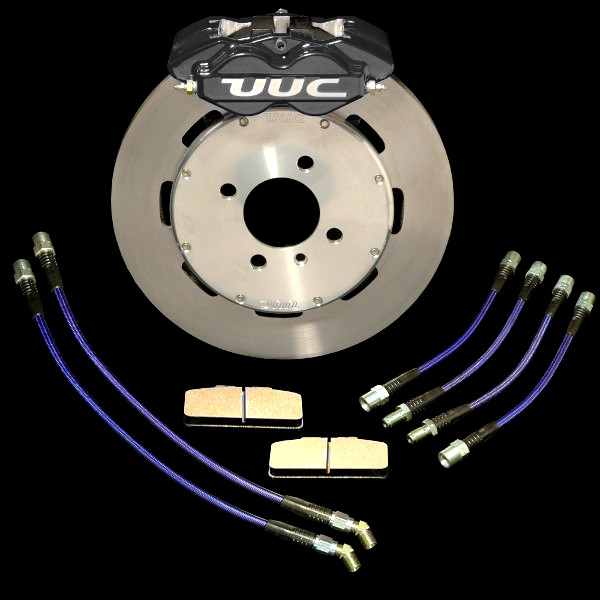
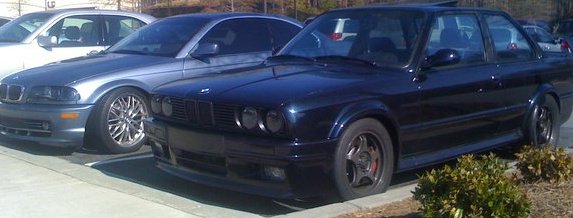
The hats in that particular picture have been in use for about 15 months on that car, which gives you an idea of how long we've had these calipers in daily use/testing.
That picture of the well-used setup was taken on my personal '88 325iS with S52/6-speed:
- RobLeave a comment:
-
To answer a few questions raised so far:
---------------------------------------------------------
"Any plans for a matching rear kit?"
Yes and no. This is my honest answer as reflects the entire scenario of a matching rear kit:
Our front kit is designed to be correctly balanced (as to brake bias) with the original rear brakes. No change to the rear brakes (other than matching or similar pads and the SS lines which we automatically include) is necessary to retain proper bias. A good brake upgrade is not just going "huge"... in fact, if you review all of our competition brake packages for other BMW models, our rotor and piston sizes are "appropriate". Heck, if you want to stuff a zucchini in your pants to make an impression, that's one thing... but just having oversized is not the entire recipe for upgraded performance brake systems.
The problem with doing a rear brake kit is the expense; as you can see on your own E30, the rear rotor's central hat is very deep. To build this as a 2-piece rotor like our fronts would require a large piece of aluminum with much of the interior machined away... which would make it substantially more expensive than the front kit.
Knowing the frugality of the typical E30 enthusiast, the necessary price of nearly $1400 for the rear kit would likely deter many potential customers.
I'm not saying we absolutely will never do a rear kit - I am saying no at this time.
Another thing to realize is that from a true performance perspective, especially with engines that are not gifted with an overabundance of torque, keeping the rotating mass of the drive wheels low is beneficial. Adding large rear rotors has the same effect as heavy wheels, your car will accelerate slower.
-----------------------------------------------------
"Is it normal that the pads rub below the friction surface?"
With that particular rotor, yes. We're using a genuine Wilwood rotor, and it is the spec design for that pad shape. The fact is, the difference is about a millimeter or so and has no impact on the brake system performance, noise, or dust.
There are alternate rotors from Wilwood that are cut a little differently that have more material there, but quite frankly, I don't see that as worthwhile for the expense for the majority of users.
-----------------------------------------------------
"What type of rotor is used?"
Genuine Wilwood UL-32 rotor that they do call "light duty"... which is amusing to me as we've got MOD-class racers using this rotor know for a few years, as we've been using this with our previous Wilwood caliper kit.
If there is the desire to upgrade to a different Wilwood rotor, we will gladly make the swap. The beautiful thing about the UL-32 is the replacement cost, about $40 each disk. An upgrade to the Wilwood 160-7701 HD-36 rotor would be about $90 additional to the kit. If this is something a potential purchaser of the kit would like, we request that they call us for the substitution.
--------------------------------------------------
"What kind of duty can the kit widthstand?"
From what we've seen so far, potentially anything reasonable on street or track. As above, we've had MOD racers using our previous kit with excellent results. No complaints, no issues... the only time we hear from these guys is when they're ordering replacement pads and rotors!
Our caliper is built to the highest racing standards with high-temp seals and stainless pistons, with a caliper body stiffness that equals or exceeds similar Wilwood calipers.
The best part about the caliper is the built-in mounting. Take a close look at some of the pics... there's a significant amount of material there, no issues with flexible brackets.
--------------------------------------------------
"Are the rotors with straight vanes or directional vanes? (diectional vanes greatly improve cooling)."
As above, the UL-32 rotor. It's got straight vanes. A correction to a common misconception or marketing device... curved vanes are not "greatly" improving cooling. They are incremental improvements, not monumental.
More important factors in thermal management (which is the "big picture" in a performance brake package) is caliper heat isolation, pad choice, and the airflow that really makes a difference - ducting.
--------------------------------------------------
"Is the kit using a fixed or floating discs system?"
Floating? On an 11.75" rotor? What's the point? Are these going on 200mph Formula1 cars running 13" slicks?
With this diameter, thermal expansion is minimal. Adding the cost, complexity, potential for rattling, and hardware wear factors into the mix do not present themselves are reasonable.
Again, my MOD racer example is the "proof in the pudding". I have yet to see an E30 in a motorsport exercise with greater speed or power, and this exact rotor configuration has been serving them well for years.
----------------------------------------------------
"What are the pad thickness and area?"
Wilwood 7212 pad shape, cross-reference to Hawk HB237:
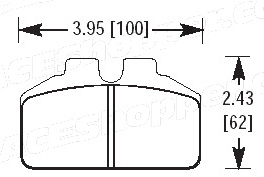
We've chosen the .480" pad thickness variation to minimize caliper excursion beyond the wheel hub plane.
One of the primary design goals of this bespoke caliper was to optimize wheel clearance. Thanks to trimming a few millimeters here, a few millimeters there, this design uses absolutely no spacers with some of the more popular race wheels, and the smallest of spacers with standard wheels, including the OE BMW 15" option.
One may make the point that a .480" pad is not very thick - yep, it's not. So you have to change it more frequently. With this pad shape being so reasonably priced at around $55-$75 a set (depending on material), who cares? When you compare this to the typical Wilwood 7420 .800" pad costing $95-$160 for the same materials, you can see there is direct cost parity.
Truth be told, I'd rather replace race pads more often any way. One issue we've seen with thicker race pads in our many years of track and race experience is that repeated heat cycling of a track pad will make it "cook out" - they lose effectiveness. We usually replace the thicker race pads before they've worn out simply because they don't work as well. From that perspective, the thicker pads are less of a value.
--------------------------------------------------
"How stiff are the calipers?"
As above, the equal or superior of any comparably-sized caliper. There is no reasonable cross-brand stiffness factor that is realistically measured, so the question itself has little objective value.
But from a cursory comparison to Superlite or Dynalite/pro calipers, you will notice that ours have more "beef" in the important structural regions, especially the mounting lugs. Our mounting lugs are over 20% thicker than Wilwood (and steel hardware enforced), and fully 100% wider.

----------------------------------------------------
"What material are the pistons?"
Stainless steel, all the way.
----------------------------------------------------
"How many pad compounds are available for that caliper?"
Wilwood: A, B, E, Q, CM, BP-10, and BP-20.
Hawk: all major compounds, including DTC-70, DTC-60, DTC-30, DTC-05, Black, Blue, HT-10, HP-Plus, HPS.
EBC: Greenstuff, Redstuff, Yellowstuff.
Pretty much any manufacturer that makes a Dyna-fitment pad will either have the exact shape, or a minor modification will allow their pads to fit.
Keep in mind something very important about anything you would ever get from UUC... we don't hide our designs or product characteristics. Just the opposite, in fact - our website is often an "instructional guide" on our components, appropriate uses for them, why a product may (or even may not) be the right fit for your needs.
With our new E30 Direct Fit Caliper brake kit, which was truly a "clean sheet" design, we've weeded out all of the unnecessary fluff of big brake kit parts that are not needed or are over-priced.
By dedicating a design exclusively to the E30, we've been able to make, in our humble opinion, a perfect match.Leave a comment:
-
Everybody definitely should... and see my response!
Not that I am aware. :mrgreen:
Not sure what you mean... ?
A few significant reasons:
- Eliminating the bracket is just one less connection point for hardware to come loose.
- Designing the caliper specifically and exclusively for the E30 enabled us to optimize fitment and wheel clearance.
- Display a level of engineering and manufacturing beyond machining a simple bracket.
"More" money? At full regular price, it's $1099... intro price is $999. The weekend deal makes it $850. For that money, you get professional race-grade calipers, 2-piece rotors, real Hawk pads, and stainless steel brake lines for all four wheels (which would be over $100 anywhere else anyway).
What could be had for less money? Used other-marque calipers and 1-piece rotors that require special modifications every time they need to be replaced? That's not exactly a comparable item, is it?
A-ha! Now you see one of the specific design features of UUC brake kits... you can get replacement parts anywhere! The rotors are a standard Wilwood 11.75" rotor with 8x7.00 mounting that you can buy from any Wilwood dealer, pads are a standard Wilwood 7212 or Hawk HB237 shape, and even replacement piston seals interchange with standard Wilwood parts.
If you're at a racetrack and have an OG Racing store, it's likely that all the parts are right there waiting for you.
How nice is that? We've designed these kits the way we would want them if we were the consumer... easy to service, affordable to purchase.
Thanks for the opportunity to answer your questions.
- Rob Levinson
UUCLeave a comment:
-
I believe what you are seeing is the stain of the extra holes of a dual pattern wheel or spacer.
"All consummable parts easily available; uses a standard Wilwood pad shape (7212) or other-brand equivalent and standard Wilwood 11.75" rotor."Leave a comment:
-
Leave a comment:
-
Lee's posts Here are very relevant, and for me informative.
excerpt quote:
"I believe any customer should ask a few other questions to determine if it is what he needs.
1- What type of rotor is used? Light duty? Heavy duty?
2- What kind of duty can the kit widthstand? Light, medium, heavy.
3- Are the rotors with straight vanes or directional vanes? (diectional vanes greatly improve cooling).
4- Is the kit using a fixed or floating discs system?
5- What are the pad thickness and area?
6- How stiff are the calipers?
7- What material are the pistons? (Stainless and titanium will keep heat from reaching the fluid)
8- How many pad compounds are available for that caliper?
You can ask the questions above to any supplier, and you shall know if it is the kit for you. Not everyone has the same needs." end qouteLeave a comment:

Leave a comment: