

 :)
:)
-
I guess someone with 2618 has to make an input. Cause you guys are only 4032 gathered here.:)
-
-
-
-
improper circlip install was my first thought as well. Unfortunally pictures in that post were not good enough to focus on areas of interest for telltail signs of circlip failure: opposite/undamaged side piston balcony area, rounding of the edges on the broken side, circlip marks on the side of the wrist pin or the lack of, etc.Leave a comment:
-
That's my point too.
Internet is a great place to learn from but there are people there who know a thing or two about alloys. And about metallurgy science.
Otherwise, it is great to learn from the internet. :)Leave a comment:
-
ive crunched the numbers and built fea models with piston pins and rods so I couldn't care less what you think but maybe someone else reading this might pay attention to the details rather than look at everything simplistic or black/white when the world is mostly greyLeave a comment:
-
Wrong, Digger.
It's all about RPMs.
Nothing loads the whole piston-pin-rod assembly like the RPMs.
You can boost an M20 engine as much as you want, but if it stays at 6k RPM with the right tune, it's all good.
Try a N/A engine at 7.5K and you'll see the difference in how all that iron starts to surrender.
That's why everyone boosts M20 and a few go for a high revving N/A M20.Leave a comment:
-
The engine revs same as a stock engine with chip and cast Pistons have no issues even st 7k and they are a lot heavier with the same 5mm pin boss wall thickness . Compression loads flex the pin and piston bosses have to withstand that it's a very common problem with the crowd that thinks lighter is better.
I've done about 100000 miles on my 4032 pistons revving over 7k many many times but no can't be done....lolLast edited by digger; 10-17-2017, 12:32 PM.Leave a comment:
-
Turbo charged or not, doesn't matter. What matters is the revs.
It is the revs that put an enormous load on rods, pistons and pins. Not the boost. Period.
@SkiFree - while you are being generous about the 2618 alloy, how come you never mentioned this before (30K miles)? I guess you sold quite a lot of pistons of this alloy while working for IE?Leave a comment:
-
Andrew, it is a 2618 piston if its JE and it's turbo charged imo I base this on the forging they used
Je diagnosed it as inorrect install saying the locks came out of groove and pin moved out of position. It doesn't look like good fi pin imo looks very thin wall so the pin flex works the piston bosses.
Regardless of the alloy on any part the geometry has to be appropriateLeave a comment:
-
Yikes, please remember that engineering IS ALL ABOUT "trade-offs".
For example, the negative "trade-off" of using the 2618 alloy on a 89.6 high-rev NA build means that with the standard 135mm rod (Stock,M52/S52,aftermarket, etc.) your wrist pin is heavily encroaching on the oil control ring, which coupled with the larger piston/bore clearencing needed with the 2618 alloy means high rates of blow-by and general wear while you are waiting for the engine to get up to temp. Even with the best of care, that engine will not last past two active race seasons or 30k miles street-driving (that's me being generous).
This is experience coming from speccing hundreds of 2618-alloy M20 pistons.
As for your link, I'm unclear where that is a material failure or a design failure... for that matter it doesn't even say what alloy was used. I'd be happy to post a couple examples of 2618 failures.Leave a comment:
-
Regardless of the "trade-offs" in any case I wouldn't take the risk of having a brittle and fragile piston in a high CR and a high revving 89.6 stroker engine.
I wouldn't much like to see a similar picture like this:
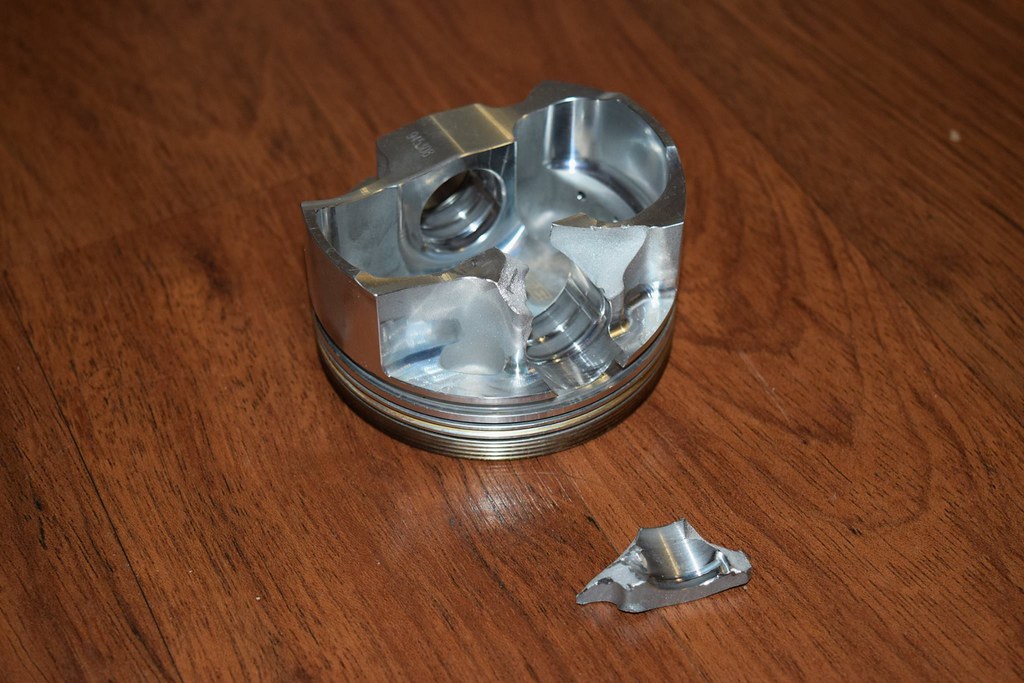
Leave a comment:


Leave a comment: