
Because you have friction and contaminants from metal on metal contact in the S54. In the viscous you only have silicone on metal... very, very little wear on the metal if any.
Agreed, in friction-clutch style LSD. And in the torsen you just have gears, producing very little wear in comparison. But I don't see how the viscous diff would wear out. Maybe if you overheat/cook the fluid (happens when an IX gets towed with only the rear tires on the ground).
-
-
I never said it didn't work!~!! Many of my 240SX friends with Welded diffs can drift circles around me - That would be SKILLzzzzz!!! not setting :)
IF we switched cars and I was driving the welded.... oh my. I suck at drifting a welded, I'm unskilled when talking about boro-drifting, not bad on a track doing full speed enter/exit drifts during lapping sessions :)
Open = grandma
viscous = for your subaru to go tahoe with
Torsen = for street car, HPDE car
Welded = if you dare or must because of budgeting reasons
LSD = the proper setting. all sorts of variation in this one!!!
Personally, I'd rather drift a Torsen than a welded - but I'm a Lap time guy, the turn in with welded just SUCKS.Last edited by Wanganstyle; 05-18-2011, 10:38 AM.Leave a comment:
-
-
Info from a Vauxhall Viscous Transfercase... May be similar in design to the 325IX differential.

1. Drive from front wheels 5. Connection for Rear Driveshaft
2. External Disc A. Drive from Transfer Box gearing
3. Internal Disc B. Drive to Rear Wheels through 5.
4. Housing of the Viscous Coupling
As can be seen above, the Viscous Coupling (VC) is a completely sealed, drum shaped unit and resides at the "rear" of the transfer box assembly. Contained within this unit are 2 different types of steel plates or discs all of which are immersed in a silicone fluid.
The interior discs are slit along the entire radius of the plates as can be seen in Point 3. of the above diagram. The inner discs are also connected to the front wheels via a driveshaft by the teeth that form the inner edge of these plates.
The exterior discs have holes punched in them and these also cover the full diameter of the plates (Point 2. above). The exterior discs are connected, again by teeth, with the housing of the Viscous Coupling which is bolted to the rear driveshaft that is connected to the rear wheels. These teeth form the outer edge of the exterior plates as can be seen above.
And this is how the information about the numbers of revolutions (speed) of front and rear axle arrives at the Viscous Coupling which is then used to determine wheel slip.
Within the Viscous Coupling, an interior disc (slit plate) immediately follows an exterior disc (punched plate). This repeats itself many times but NONE of these plates physically ever come into contact with each other. The whole unit, as mentioned above, is then submerged in silicone fluid which is how the drive is transferred from plate to plate.
How the Viscous Coupling Works:
Under normal conditions, the drive is split so that 75% of the power is driven to the front wheels and 25% is driven to the rear wheels. The secret of the Viscous Coupling is based in the silicone fluid it contains.
When driving normally, the difference in RPM (rotational speed) of the front wheels and the rear wheels is minimal. That is they are travelling at virtually identical speeds. This also means that the internal discs and the external discs are also turning at the same speed as these are connected to the corresponding axles.
If the speed of one set of wheels were to be more than the other, for example the front wheels lose grip so spin faster than the rear, then the difference in speeds of the corresponding disc's in the Viscous Coupling will also increase proportionally. In this case the inner discs would spin faster than the rest as these are connected to the front wheels.
This difference in speed of the discs means that the silicone fluid can no longer flow freely between the plates. This would cause a "cutting" action within the silicone fluid as it is sliced between the slits of the interior discs and the holes of the exterior discs resulting in the silicone fluid heating up instantly -

1. External Disc
2. Silicone Fluid
3. Internal DiscLeave a comment:
-
-
I disagree with welded diffs for drifting. It's not ideal but it will get you sideways.
Drifting:
open<viscous<torsen<welded<real lsdLeave a comment:
-
-
So yeah, welded = not good for anything other than drifting/drag racing.... lolLeave a comment:
-
Actually matters for Drag racing and drifting:
Drifting with a welded makes your angle different, as soon as you lift you start sliding- with a LSD you can enter with less understeer and more speed, use the power of the engine to spin tires after you transfer weight forward instead of the brute locking of a welded diff.
Drifts with LSD look better IMO and allow to run a cleaner more classic line -drifting is all personal style anyway, some people make do with a welded very well for various reasons (usually $$$)
Drag racing a spool is harder on your axels/driveline/transmission than drag racing with a limited slip. This matters if you make enough power and have the traction to hook up and break things!!!
Welded diff gets axel hop = destruction, serious unsettling. The group 5 full racing E21's with hallibrand+spool would have to take some corners / turbulence sections carefully to avoid axel hop at high load while cornering
Welded units also destroy Axels, Driveshafts. Not at all good for independent suspension cars
Spools (1 piece billet welded diff) for drag racing use are usually used in Live axel cars, as the axels are always moving as a unit in its housing-
This is a spool (proffessional welded diff without the ghetto)

this is garbage spool (welded diff)
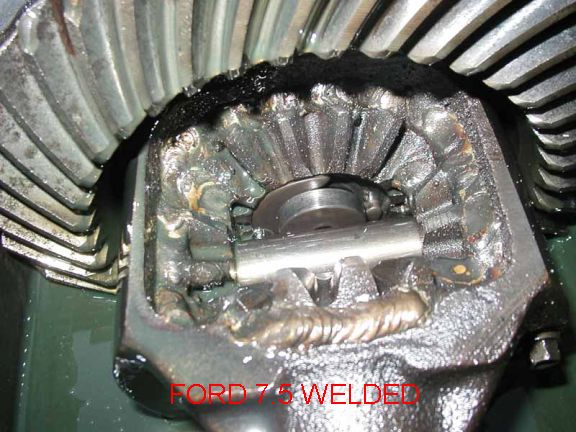
Leave a comment:
-
Viscous LSD has a fluid and plates also, they can wear or not be OEM spec'ed to handle the load you throw at it.
350z has OEM vlsd that will turn = open if you bolt on footwork+ sticky tires on the car.
heres an article to VLSD rebuild, reconfig:
they add a $4 shim to the stock Viscous setup to revive and make it artifically grab more. It dosn't live that long though, usually the guys kill them drifting in 6m-8months time.
http://zilvia.net/f/s-chassis/200226...-j30-vlsd.htmlLeave a comment:
-
Wangan, can you explain to me how viscous e30 diffs wear out? I've never pulled one apart and it seems really interesting to me. Subscribed.Leave a comment:
-
JakeP - this thread isn't about drag racing, or drifting, where a welded diff is at home. For everything else a welded diff is not a good idea.
As the car is turning or trying to accelerate out of corners, left and right side wheels aren't spinning at the same time.... welded diff is not ideal in this case. Now for drifting or drag racing it doesn't matter as much.Leave a comment:
-
Viscous units come standard on nissans, they definitely wear out!!! They can be shimmed for more lock up as well! Nissan sells those parts Oem.
Welded is in theory good for some setups but has problems like wheel hop, etc etc. Also destroys drivelines- much more ideal in live axel cars.
Bmw actually spec'ed a welded diff in a factory car in the 80's:
E21 group 5 had a spool in the hallibrand quick change unit that was spec'ed with standard cv axels for the e21 320 group 5 cars; bmw custom fitted a hallibrand 10" differential into the e21 chassis for pure factory racing purpose. Very very hard core modification!!!
It was a spool unit (meaning solid, what a welded is trying to be).
If you know what that is; it's not for street use!!! Nor is a quick change diff!!Leave a comment:
-
viscous diffs wear out over time. You want more lock, not full lock. there's such a thing as too much lock. http://www.r3vlimited.com/board/show...ghlight=weldedLeave a comment:

Leave a comment: