

Rob
Looks like a quality product. I would love to knock 4lbs of unsprung mass off each wheel, get better breaking and still be able to use 15" wheels. When it comes time to get brakes for my e30, I will be looking your way.
A rear kit would be nice to see as well.
Dave
-
-
Wheel fitment diagram now available, download link on this page:
http://www.nexternal.com/uuc/Product563
Leave a comment:
-
well now i wish i had $850 to spend. i would be all over a set from you.Leave a comment:
-
Yes, you are correct... and are referring to galvanic corrosion.
Just as another detail to clarify with our calipers - the mounting bolts do not thread into aluminum. We have a stainless steel nut built into the caliper lugs for maximum strength and corrosion resistance.
It couldn't hurt to apply a thin layer of lube between the caliper feet and the steel hub lug.
- Rob Levinson
UUCLeave a comment:
-
I don't want to get in the middle of a poo flinging contest here, nor am I taking sides. But this is not entirely true.
Yes in air aluminum doesn't corrode, this is because aluminum is a re-active metal and oxidizes rapidly in air. The oxide layer forms a coating that protects the aluminum. Anodizing is a variation of this only it builds the oxide layer thicker to better protect the aluminum.
The problem with aluminum is when bare aluminum is in contact with bare steel, as it looks to be on your caliper. Aluminum being re-active will re-act with bare steel causing something known as "flash corrosion." Which causes rapid corrosion and pitting of both metals, this is why aluminum rims often get "stuck" to steel hubs.
In my opinion you should recommend that your customers spread white lithium grease over the mounting lugs to prevent this corrosion. I do this when I mount aluminum rims on any vehicle. Obviously this is minor and seems nit-picky but bare aluminum in contact with bare steel is a bad thing. I do believe there were lawsuits against land rover for their aluminum bodies corroding due to being in contact with steel.Leave a comment:
-
thank you for the thorough response! i like the idea of shedding 4lbs off per wheel while increasing braking power significantly!Leave a comment:
-
Here's the info side-by-side for easy comparison:
UUC caliper: 4lbs
UUC rotor with aluminum hat: 9.6lbs (or 8.7 with drilled rotor)
UUC TOTAL: 13.6lbs (or 12.7 with drilled rotor)
OE caliper+bracket: 7.5lbs
OE rotor: 10.2lbs
OE TOTAL: 17.7lbs
You can keep them if you choose (corners have to be trimmed or bent slightly). You don't need to keep them, and removing them will not have any significant effect on the tie rod boot. It's still 8mm away... you can hold your finger 8mm away from a really hot rotor and all you will feel is a little warmth. The advantage to keeping them with a car that sees mostly street use is protection from water splashed up under the car. The advantage to removing them for a track or race car is better heat dissipation.
They already are available in black - it's an option on the website! We can also powdercoat them in almost any color you like (not matching BMW paint codes exactly)... some colors cost a little extra, but we've done a lot of wild colors - metallic orange, yellow, light blue, dark blue, silver.
Yes. Pads change from the top, just remove the bridge bolt and the pads come out like toast out of a toaster. New pads drop right in.
Certainly. Staggered pistons are designed to apply pressure to the pad unevenly. Why would you want to do that? The reason is to minimize or eliminate tapered pad wear. Tapered pad wear, where the leading edge of the pad wears more than the trailing, is an artifact of the physics of pad-to-rotor interaction. When a pad is pressed against the rotor, the leading edge digs in while the trailing edge wants to lift up.
By staggering the piston sizes, the trailing piston applies more force, which gets that trailing edge of the pad properly pressed against the rotor. This evens out the pad wear, taking full advantage of the pad surface area, which improves brake response and pedal feel.
- Rob Levinson
UUCLeave a comment:
-
Yes. I like those 5 questions. More interested in 2, 3(other colors mainly and what cost) 4 and 5. 1 is good but not as important.
Thanks Rob. I can say that driving/riding in cars equipped with UUC brakes, swapping pads at the track on cars equipped with UUC brakes... I was impressed. I can't say I have any directly experience with a Massive kit of any type so I cannot really comment and my opinion is obviously biased.Leave a comment:
-
yes i have 5:
1- you gave the weight of UUC setup, can you provide the OEM setup weight for comparison? weight is an important selling point for me and good info to put out.
2- should the OEM heat shield be kept with the UUC setup? if not, will this compromise tie rod and control arm boots due to heat?
3- will they be available in black instead of flashy red?
4- can you change the pads without removing the caliper?
5- can you explain staggered piston sizes a little more?Leave a comment:
-
Wonder what the 'local/friend' price is? hehe
*EDIT*
GREAT! More reading...Leave a comment:
-
Why? Big concept here: precision.
Any coating, even anodizing, adds material. Material that can vary slightly in thickness.
By leaving the metal bare at the contact points, precision is assured. As for mounting points and pad installation, we prefer to keep the CAD-designed precision intact.
Will it corrode? Are you in need of a lesson in how aluminum oxidizes?
The only oxidizing effect that aluminum ever experiences is the production of a very light white powder. Within a brake caliper pad area, this is a complete non-issue... it's going to be covered in brake dust.
Actually, you're completely right. In the pics, that is a production-quality prototype and the masking on the lugs is slightly different than production parts.
If you're seeing any splotchiness, it's from the JPEG compression (or dirt - that set in the pics have been used for awhile)... due to size limitations in our online web store database, that's a 75 JPEG compression factor.
Anodizing is a second choice for a caliper used on a street car.
Lee, ask your own customers what happens to the black-anodized Wilwood calipers... wheel cleaner eats away anodizing, leaving it hazy and streaky.
For a caliper where the owner is concerned how it looks, powdercoating is an ideal choice as it is durable, impervious to wheel cleaner, resistant to chipping, and resistant to brake dust. It cleans up to look "like new" with normal soap and water.
And as you already know from this post:
...we use powdercoating... Just like Performance Friction, Alcon, Brembo...
...if an enthusiast wants us to supply a bare aluminum caliper (which you must think clearly more heat-dissipative than all that insulating anodizing!), we can do that too. That's the freedom of being a manufacturer, infinite customization.
Speak with a metallurgist, Lee. The cast DynaPro is actually a cheaper caliper to make. I'd love to start with a casting and machine in a few holes... manufacturing a cast caliper costs about half of what a 100% billet piece costs.
You already know the answer to this because it was posted here:
Again, this boils down to basic manufacturing knowledge and a lack of knowledge of the details of our caliper:
1) These caliper halves are asymmetrical because of staggered piston sizes. That means we are actually making four different caliper halves.
2) Yes, it's necessary to bore through from the sides. Boring a hole that turns 90° is extremely difficult, and greater precision is achieved by boring two intersecting holes and plugging one access hole.
3) The second two holes are plugs, not bleeders.
This exhibits a fundamental misunderstanding of the way those calipers are made.

Are we not seeing the same thing? PLUGS. See the plugs at the top and bottom?
And as for "knowing how to do it..." you have a choice - make a cast iron caliper like that which weighs around 15+lbs, or make a compact aluminum design that weighs under 4lbs.
Which is smarter?
Not impressed by your distortions of fact, ignorance of technology, and attacks on a competitor.
NEVER. Wilwood does not publish ANY data on stiffness/flex at all. All they ever say is "less than other designs". Doesn't say if it's less than their design, Brembo's design, or some old Girling design.
Really? Which manufacturers publish accurate stiffness data?
All of them keep those numbers to themselves. None publish it.
The only nonsense publication I've ever seen is from one of the Chinese manufacturers who published something about "burst strength" when they pressurized a Wilwood caliper to 20X it's normal operating parameters and, surprise, it blew up. More advertising distortions by companies that attack others. ;-)
You've measured our hat? Really?
Inner face of our rotor is at the exact same plane as the OE rotor... which is a bare couple of millimeters away from the dust shield... which is also just a bare few millimeters away from the steering knuckle.
So if your thicker rotor is somehow more inboard, then you've performed some type of amazing time/space alteration that lets two objects exist in the same place at the same time.
You're saying that "you think" your rotor is 13mm further inboard than my rotor, which is 8mm away from the steering knuckle?
Your rotor is existing 5mm within the steering knuckle. Sharing space. Black hole technology, right?
Anybody think that's possible?
Here's the reality:
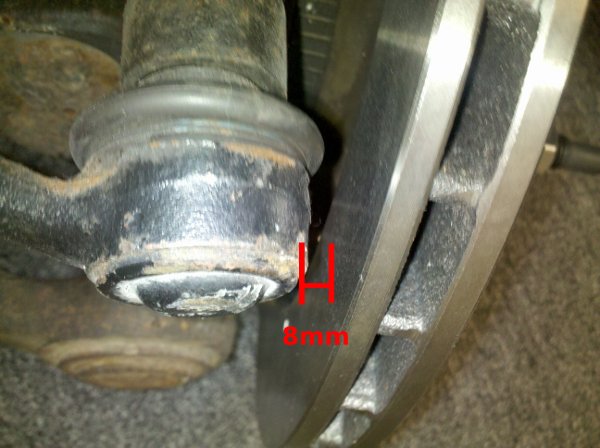
I'd really like to have that kind of technology... WOW!
Or is it perhaps some form of hyperbole, more distortion of facts to make our product look bad?
From what I'm seeing, taking your word for any details here would indeed be a mistake.
See, that's the difference in how we present a product.
If a kit should have parts X, Y, and Z... it gets parts X, Y, and Z. No sourcing calipers here, rotors there. The customer gets all the parts they need, all at once.
Lee, please don't tell me my costing or analyze what things "should" cost in a kit. As we manufacture these parts, including the lines, what price we choose to bundle them is the business of the customer only - not you.
WARNING: YOU HAVE JUST SEEN AN EXAMPLE OF ALARMIST PROPAGANDA! :nice:
UUC lines are street and race proven for many, many years now.
You want to know who uses our lines?
These guys:
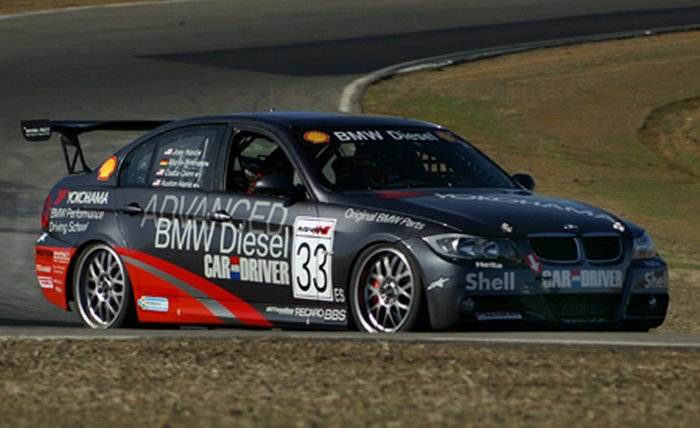
Yes, that's an official BMW NA racecar using UUC brake lines.
And here's another one:
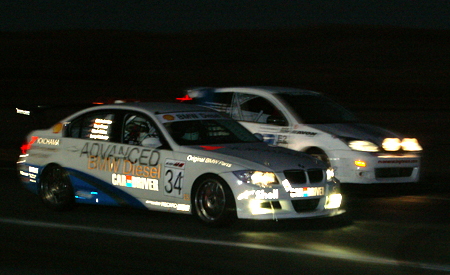
If a car prepped for BMW's 25 Hour ENDURANCE race efforts uses UUC lines... it's safe to say they'll work well on any street/track/race E30.
I welcome any and all legitimate questions about the product. Hopefully the E30 enthusiasts here can tell the difference between technical fact and competitor counter-marketing.
- Rob Levinson
UUCLast edited by Rob@UUC; 03-16-2010, 02:23 PM.Leave a comment:
-
Lee, I am seeing we're having the same discussion as we had two years ago, that fits the observations of others as to how you deal with competition... which is to completely ignore the facts that you have already been presented with and to substitute some amusing distortions!
Fun!
Now let's begin the corrections and repeating the information you already know:
I'm not inclined to comment on your kits at this time. Attacking a competitor is not something I need to do.
You already saw the answer to that here:
And the apparently necessary re-post of the answer:
With that particular rotor, yes. We're using a genuine Wilwood rotor, and it is the spec design for that pad shape. The fact is, the difference is about a millimeter or so and has no impact on the brake system performance, noise, or dust.
There are alternate rotors from Wilwood that are cut a little differently that have more material there, but quite frankly, I don't see that as worthwhile for the expense for the majority of users.
(We're using a) Genuine Wilwood UL-32 rotor that they do call "light duty"... which is amusing to me as we've got MOD-class racers using this rotor now for a few years, as we've been using this with our previous Wilwood caliper kit.
If there is the desire to upgrade to a different Wilwood rotor, we will gladly make the swap. The beautiful thing about the UL-32 is the replacement cost, about $40 each disk. An upgrade to the Wilwood 160-7701 HD-36 rotor would be about $90 additional to the kit. If this is something a potential purchaser of the kit would like, we request that they call us for the substitution.
$849 kit. $99 more than your kit using 1-piece Corrado rotors that require a custom center bore.
Tell us, Lee, what do you charge for replacement modified VW rotors? And what's the shipping cost to a USA customer? And what is that customer to do if they are at the track and need those rotors the same day?
That is a great idea!
As you read earlier, when I posted here:
An upgrade to the Wilwood 160-7701 HD-36 rotor would be about $90 additional to the kit. If this is something a potential purchaser of the kit would like, we request that they call us for the substitution.
And you read the answer in the same single post:
We've chosen the .480" pad thickness variation to minimize caliper excursion beyond the wheel hub plane.
One of the primary design goals of this bespoke caliper was to optimize wheel clearance. Thanks to trimming a few millimeters here, a few millimeters there, this design uses absolutely no spacers with some of the more popular race wheels, and the smallest of spacers with standard wheels, including the OE BMW 15" option.
One may make the point that a .480" pad is not very thick - yep, it's not. So you have to change it more frequently. With this pad shape being so reasonably priced at around $55-$75 a set (depending on material), who cares? When you compare this to the typical Wilwood 7420 .800" pad costing $95-$160 for the same materials, you can see there is direct cost parity.
Truth be told, I'd rather replace race pads more often any way.
One issue we've seen with thicker race pads in our many years of track and race experience is that repeated heat cycling of a track pad will make it "cook out" - they lose effectiveness. We usually replace the thicker race pads before they've worn out simply because they don't work as well. From that perspective, the thicker pads are less of a value.
Not a problem from our racers that have already been using the same pad and rotor components for years.
YEARS.
Lee, you're smarter than to make such a statement.
"Gosh, I think SSR ripped off BBS. I've seen a wheel design like that before - it's round and silver."
You're making the same kind of absurd comment.
All calipers look roughly similar. Any two calipers using the same pad look very similar. Form follows function. That's common sense.
That's a really distorted way to look at that.
The mounting hole spacing matches the E30 hub spacing. As it's a direct bolt-on, that's what they match!
Or are you suggesting that to be "unique", it should be something different than what it's designed to fit?
It's in no way, shape, or form related to any of the pre-fabricated calipers.
(continued in next post)Leave a comment:


Leave a comment: