
What are people using as a setup free clearance for the front coilover bump stops, as in at ride height what travel before the bump stop makes initial contact? 1", 1.5", 2" ?
it is my understanding the micro-cellular polyurethane elastomer bump stops will compress about 50-60% of their free length so in the order of ~30 mm (1.25") before the rate get so high it is essentially "solid", and that this adds to the total travel. So a clearance of say 1.5" means total travel 2.75" (assuming spring doesn't get to solid/block height first).
I am using ground control shortened struts, koni shocks and the GC bump stop but not running super low (the tyre is roughly about 40 mm below front guard).
When I play around with settings of different length springs and adjuster positions it seems like the bump stop may need to be longer when the adjuster to nearer to the top to avoid the spring becoming solid before the bump stop fully engages.
A 6" 450 lb/in spring solid length is 2.39" 61mm
A 7" 375 lb/in spring solid length is 2.65" 67mm
A 8" 275 lb/in spring solid length is 2.72" 69mm
For example, if the lower spring perch at the top of the adjuster range see image I found in google showing adjuster at the top. By the time the bump stop compresses 50% the spring would have gone solid so the bumpstop is just a token
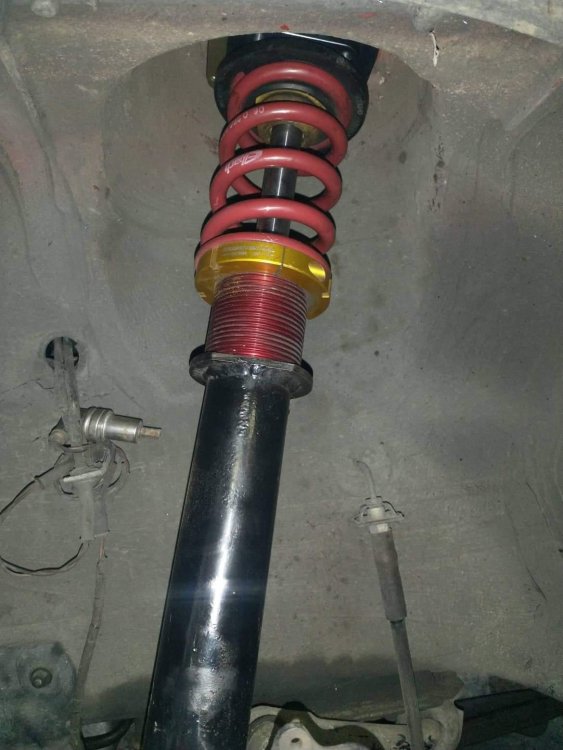
it looks like you need the spring to sit towards the bottom of the adjuster to give the spring somewhere to "hide' under maximum travel regardless of the length of the spring
Whereas this image shows the adjuster near bottom of the range

So it looks at least plausible that when the bump stop is compressed there is a place for the spring to be out of the way
So me this leads me to that if you want to run with the height adjuster in the top region of the range with this type of setup and maintain the correct engagement sequence in the event of huge impact bump that you need to either:
• Use a longer bump stop and accept the reduction in free travel
• Use a longer spring to keep the adjuster at the bottom noting that 6, 7, 8 and 10" is most common standard length for a 2.5" ID spring (noting that the longer spring has a greater block height for the same spring rate).
Of course, if you have a enough free travel then you are less likely to put enough energy in to get that much travel (especially with very stiff springs) to activate the bump stop or reach block/solid, but IMO the sequence in the extreme case should still be done correctly.
it is my understanding the micro-cellular polyurethane elastomer bump stops will compress about 50-60% of their free length so in the order of ~30 mm (1.25") before the rate get so high it is essentially "solid", and that this adds to the total travel. So a clearance of say 1.5" means total travel 2.75" (assuming spring doesn't get to solid/block height first).
I am using ground control shortened struts, koni shocks and the GC bump stop but not running super low (the tyre is roughly about 40 mm below front guard).
When I play around with settings of different length springs and adjuster positions it seems like the bump stop may need to be longer when the adjuster to nearer to the top to avoid the spring becoming solid before the bump stop fully engages.
A 6" 450 lb/in spring solid length is 2.39" 61mm
A 7" 375 lb/in spring solid length is 2.65" 67mm
A 8" 275 lb/in spring solid length is 2.72" 69mm
For example, if the lower spring perch at the top of the adjuster range see image I found in google showing adjuster at the top. By the time the bump stop compresses 50% the spring would have gone solid so the bumpstop is just a token
it looks like you need the spring to sit towards the bottom of the adjuster to give the spring somewhere to "hide' under maximum travel regardless of the length of the spring
Whereas this image shows the adjuster near bottom of the range
So it looks at least plausible that when the bump stop is compressed there is a place for the spring to be out of the way
So me this leads me to that if you want to run with the height adjuster in the top region of the range with this type of setup and maintain the correct engagement sequence in the event of huge impact bump that you need to either:
• Use a longer bump stop and accept the reduction in free travel
• Use a longer spring to keep the adjuster at the bottom noting that 6, 7, 8 and 10" is most common standard length for a 2.5" ID spring (noting that the longer spring has a greater block height for the same spring rate).
Of course, if you have a enough free travel then you are less likely to put enough energy in to get that much travel (especially with very stiff springs) to activate the bump stop or reach block/solid, but IMO the sequence in the extreme case should still be done correctly.

Comment