
^
by decreasing spending and stop threatening and regulating industry/business to beat hell you will increase revenue without having to do shit to the to the tax code up or down.
All though I think it needs a huge reform to the point of eliminating the IRS and going to a Fair tax or Flat tax and getting rid off the income taxes in totality
-
SS didn't become a ponzi scheme until the money got spent on other things. It was never meant to be a sole income but a supplemental part of retirement.
At this point though I think many would be happy to just see an end to SS taxes and end the service all together. I know it would be quite a bit of extra money for my wife and I every month.
As for taxes... we are just going to have to agree to disagree there. We need to increase revenue and decrease spending to pay off the deficit. While initially federal/bureaucratic jobs will be lost and the economy affected negatively we will at least be on the path to re-instilling confidence to our debtors and re-valuing the dollar which we need greatly.Leave a comment:
-
The article herbivor posted a few months ago showed great correlation between "supply-side" economics and stagnating middle class wages.
To me it shows without a doubt that supply side economics created great wealth, however, it concentrated it all that top.
I say leave personal taxes where they are, dramatically cut spending (the Stimulus is now included in the baseline budget) and cut our corporate tax rate to a level that will encourage business to repatriate much of the overseas earning.
But politicians are afraid to enact the very necessary reform on the Ponzi scheme that is SS or any other entitlements.Leave a comment:
-
I agree that we can learn a few things from Japan's lost decade. They had a housing bubble just like ours, only they had theirs in 1989. Then they experienced deflation and a resulting liquidity trap. They tried to use fiscal policy along with increases in the money supply to their banking institutions. From what I understand of their fiscal policies is that they had good impact in terms of getting corporations to invest money in themselves, but didn't do a good job of putting money into consumers' hands. The modest increase in their money supply wasn't enough to curb deflation and even resulted in a credit crunch because banks weren't confident enough in borrowers to invest in them.
In a nutshell, their government botched how they spent their money. I believe they should have reduced the tax burden on consumers, thereby letting the free market decide where that money should be invested in the economy. And they also should have been a bit more aggressive in increasing their money supply. The theory isn't to blame; it's the execution.Leave a comment:
-
^This guy (morrison)... uses facts. I approve.
All of these threads can (and should, but don't always) reach the same end conclusion. We need to cut spending AND increase taxes.
Sorry guys (I know alot of the fiscal conservatives here are reps/partiers) but we need to start taxing the wealthy of America again. Our distribution of wealth/income equality puts us something like 40 WORST by nation. Pretty sad. Am I saying everyone should make the same amount of money... obviously not. Just that those taking the lions share of the pie, should pay for most of the pie.
Leave a comment:
-
the problem with keynesian economics is that when it doesn't work, and there are no examples i am aware of where it has, the proponents always argue it should have been more.
its a straw man argument, like the pres arguing without the spending things would have been worse.
its odd that keynesian proponents have no evidence to show that it works, but there are all kinds of examples that an economy grows when the government gets out of the way.
so now, after 1 trillion plus in gov't keynesian stimulus that has resulted in a slowing world economy and higher unemployment, we are supposed to believe another $500 billion of the same is the solution?
really??
you cannot push on a rope. the fed can create all kinds of excess capital at the banks thru QE2, lower rates to zero, flood the economy with cash, but the fed is powerless to compel anyone or any business to use the cash.
the admin made a big mistake early on, even if herbie wants to blame this on bush. the pres assumed all this keynesian would work, when anyone could have looked to japan, or FDR, and question at least whether it would work. obamacare got center stage while the economy continued to hemorage jobs. and now obama doesn't know what to do, its an election year, and even if he wanted he can't change without losing the last of his base before next november.
we're all inbetween a rock and a hard spot.
^^nice chart btw
anyone want to see year to year what excess spending looks like, there it is.Last edited by gwb72tii; 09-13-2011, 11:49 AM.Leave a comment:
-
My chart looks correct. "Spending" and "Debt" are two different figures. The latter is affected not only by spending but also revenue and is not an annual figure but rather an accumulation of annual deficits from all previous years.
What would be more meaningful would be to look at annual revenue and deficit figures since 1900. I'll see if I can find some.Leave a comment:
-
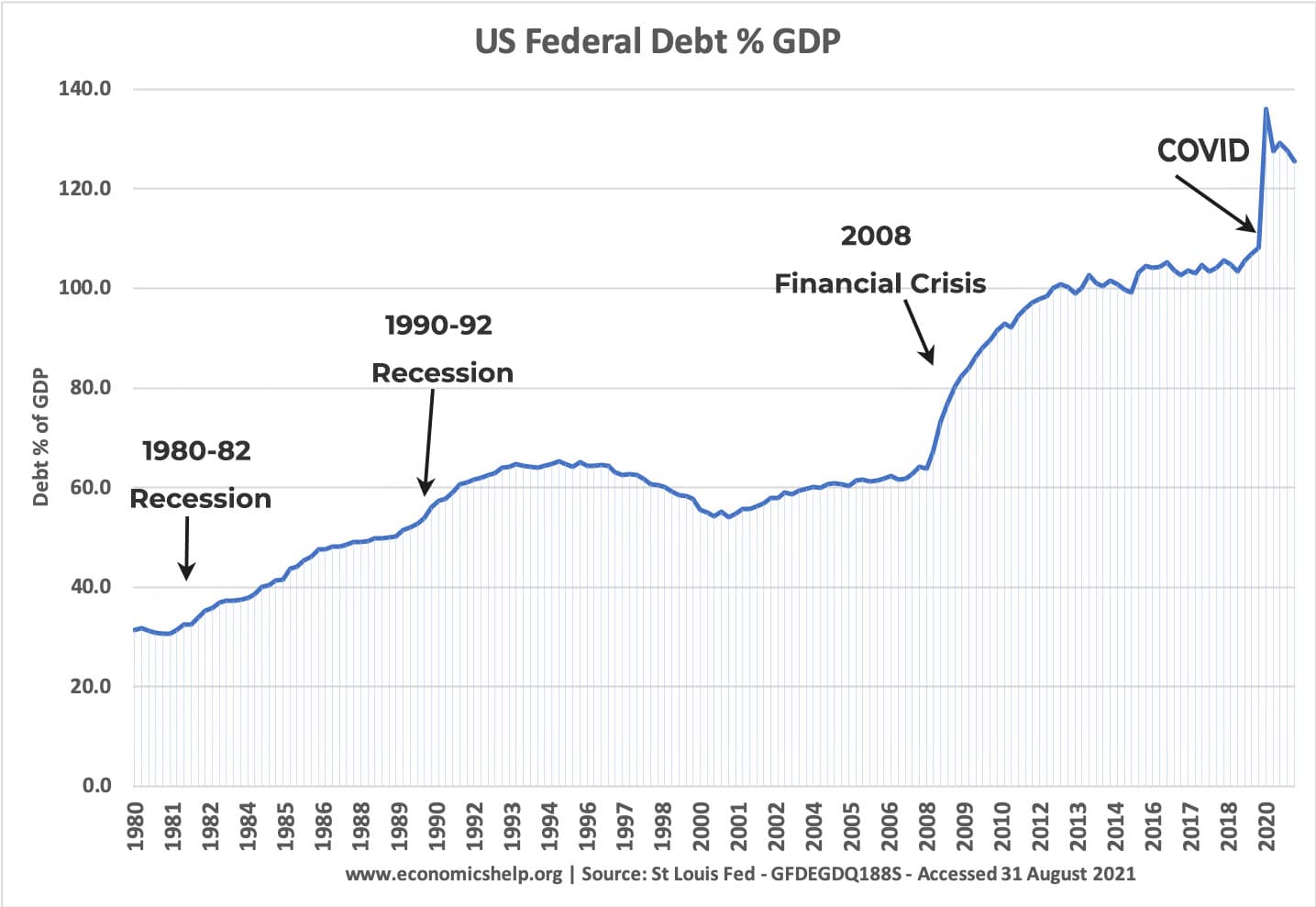
you might want to check your chart... our current dept to GDP is touching the 100% mark today. Well above FDR and your chart of 1941
Leave a comment:
-
For someone accused of spending wildly, FDR actually didn't spend anywhere near as much as what Keynes theory would have suggested that he do. This has led some to argue that he perhaps should have gone bigger with it. The graph below shows our spending level throughout the years as a percent of GDP. Notice the huge spike in 1941, even higher than 2010 levels.

Leave a comment:
-
^
Yeah fairly sure I have done that before last time you asked. If I get time to night I will see if I can find them againLeave a comment:
-
How can you know this? You can't. You're assuming that if he didn't "spend and engineer the way out of it", that the economy would have fixed itself sooner. But there is no way of knowing because that is not what happened. Show us an example of when the economy "bounced back" on its own from a major recession within a couple years without Kyensian economics and use pretty graphs like Morrison did.
ThanksLeave a comment:
-
^
there is a reason its only referred to the "great" depression here in the USA....................... and just the "depression" in the rest of the world. Its because our govt FDR tried to spend and engineer the way out of it, and there by prolonging it 6-8 years longer than the rest of the world.
FDR was a douche bag get over the fact he was elected 4 fucking times. He was so damm popular that he was not hardly cold in the ground when the Congress and the STATES adopted the 22ed amendment keeping anyone else form doing that ever again......Leave a comment:
-
History begs to differ:
The widely accepted instigator of the Great Depression was the stock market crash of October 29, 1929. Even throughout 1929 the automobile manufacturing and construction industries were contracting. Roosevelt didn't take office until March 4, 1933. This gave Hoover over 3 years to enact recovery measures, all of which failed. Unempolyment peaked at 25.4% in the spring of '33. By 1937 it had fallen to 14.3%. An 11.1% drop counts as a success in my book. GDP per person also rose steadily from '33 to '37.


The setbacks you see in the above charts occuring in 1938 are commonly attributed to the rollback of the New Deal policies by the Conservative Coalition in 1937.
Also, for the current FDR haters out there, it might be interesting to note that the people of his time approved highly enough of him to elect him to 4 terms. Even with dying 2 months into his fourth term, he still served 4,442 days in office, the longest of any president in history.Last edited by Morrison; 09-11-2011, 11:18 AM.Leave a comment:





Leave a comment: