M20 B3x Naturally Aspirated Stroker build past, present and future
Collapse
X
-
Exactly.... if car manufacturers would announce the power as whp, there would be less interest about the engine power.
But I don't see where the inaccuracy is if the dyno measures both WHP and the losses. The dyno sheet contains exactly the same whp information + losses and the calculated engine power as extra.
The dyno numbers are any way muddy waters. They are sometimes used for marketing, look for example the numbers given by VAC. Plenty of unbelievable examples are found where basic race cars are "measured" to have volumetric efficiency of best Nascar or F1 engines. Bullshit sells.Leave a comment:
-
look its fairly logical to be able to want to be able to compare an engine against what it was from the factory or against other engines which are rated in bhp which is fine, but just got to compare apples to apples.
e.g. with dynodynamics in shootout mode you can ask for either roller hp (rwhp) or estimated losses (bhp) and there is a set correction factor for number of cylinders and whther its NA or FI but this is clearly evident usually on the sheet if you know what to look for.
As long as the dyno sheet clearly says what it is i'm ok with either as even chassis numbers are sketchy at times and there is no one number that is correct. you should not be cross comparing different brands anyway even though if you define test procedure all eddy currents should read the same they simply don't.
Some systems e.g. Maha use coastdown loss estimations which are good at estimating some of losses accurately and the unknown losses are modelled so it probably works out fairly close. They certainly are not exact.
Leave a comment:
-
I would only imagine that you would reverse calculate bhp because the total number is higher and that makes the guy who just paid for all the labor on his upgrades and knows nothing about how it's attained happier.Leave a comment:
-
-
You usually want to measure the engine power, and be less interested about your drivetrain losses etc. By measuring the wheel power you can guesstimate the live performance of the car, no problem in that.
Readings of dynos are always under debate. And always dynos of others read higher.Leave a comment:
-
Yes. Weird. In Europe a lot of chassis dynos will measure WHEEL power, then reverse calculate BRAKE power. Now why wouldn't it be either use brake power measured at the crankshaft and wheel power measured at the wheels? Reverse calculating drive train loss? Just state the wheel numbers and be done with it. The post with that last dyno graph didn't give much info on how those numbers were obtained.Leave a comment:
-
-
stock manifold is good for around 220-230 whp +/- which is around 250-260 bhp+/- so yeah 235 SAE hp at flywheel is achievable.
years ago a guy build a 2.7 whith good CR stock manifold and huge dbilas cam 312 degrees or something crazy and it still fell with this ball park.
It does come down to your definition of proper powerLast edited by digger; 04-21-2020, 03:42 PM.Leave a comment:
-
You have to compare apples to apples. Is that a real wheel power number, or that weird calculation of brake power calculated from wheel power?
Leave a comment:
-
Guess you are wrong about the stock manifold not being able to produce proper power. This is my 2.7 output with the 'stock' (it's matched to the head) manifold:CURRENT and ONGOING DEVELOPMENTS
This post is for recent and current work with “bolt ons” for the 3.1L engine to prepare for the rebuilt engine
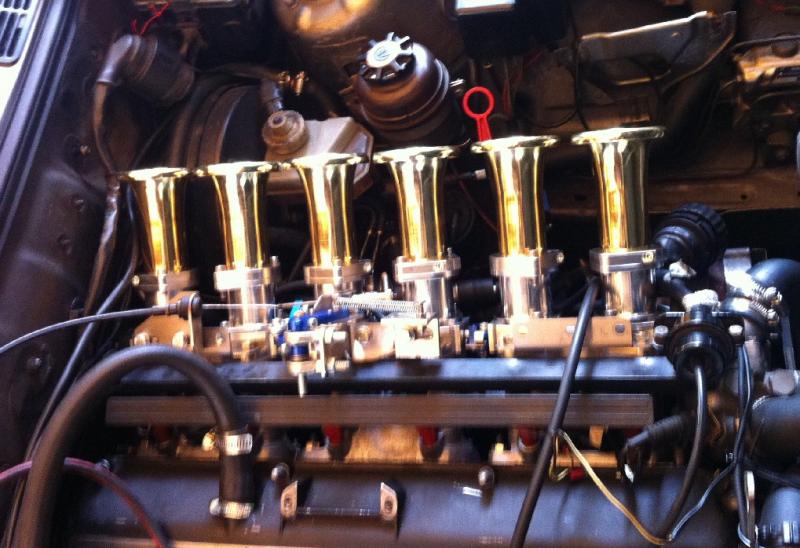
Intake Manifold:
For those of you who have seen this thread
this is new but it is a copy and paste from that thread
So in preparation for a new engine build later this year I thought it was time to get a few of the bottlenecks sorted. One of them was the intake manifold.
There are no high hp M20 around that persist with the cast OEM manifold it just doesn't have the flow or tuned characteristics to make a lot of hp. i wanted to sort something and my current engine is being used as a test mule.
I had originally thought about jenvey throttles but since RHD already had sorted the linkage, runners etc with proven results I decided to go this path. Also being significantly cheaper and a locally designed product from a guy (Rama) who knows a thing or two about high performance m20’s certainly helped the decision. i also live within an hr of his workshop
The compact throttles give a lot of freedom with regard to runner shape, design etc.
I decided on 42mm throttles because they would suit my new engine which will have more compression, a much better cylinder head, better camshaft and a few other go fast bits.
I would have chosen 40mm for my current spec engine as a 40mm throttle will support 320bhp and I was only making 250-260bhp at best on the standard manifold. I felt 42's should still work well on my old girl though strictly speaking not perfect.
IMO It is nonsense that there are kits are available with 45mm there is probably only a few naturally aspirated m20 in existence that could benefit from throttles that large without sacrificing a good chunk of midrange, this size should not be the norm.
Having done literally hundreds of dyno power runs I understood the importance of a baseline to find out as accurate as possible the benefit from doing any mods.
My baseline is well down on what it made at its best back in 2009/2010, this is due to various reason i wont elaborate on here except to say mostly to do with exhaust changes and an old engine which doesn't have the compression it used to.
Nevertheless I had a baseline with which to do an APPLES to APPLES comparison and the baseline was done only a couple of weeks before i was to convert to ITB to minimise any other chances affecting results.
1) BASLEINE: my baseline is actually a long way from stock but the cast long runner manifold still features ;)
- MM pulse tuned intake, which has tuned extensions and the end of runners are cut up and port internally
- 63mm BBTB with Silicone Elbow
- Custom big filter air box cleaner with larger K&N panel filter see here http://www.e30tech.com/forum/showpos...68&postcount=1
- Custom tuned with MAP. Back in the old days i saw significant gains in midrange and top end by getting rid of my m30afm
Tuned extensions of MM pulse tuned manifold

Ported exit

2) Part DBILAS kit: I bought the plenum off ebay and the manifold from dbilas new
- Dbilas manifold adapter, ported to reshape injector area which has a rather large bump in it. The injector angle was modified to better match port angle and aimed at valve rather than port floor
- RHD 42mm throttles and linkage kit
- Dbilas plenum with silicone reducer couplers knife edged adapter and K&N cone filter.
- Custom tuned on Alpha N (TPS)

3) RHD FULL Length Runners ( 300mm length head face to trumpet)
- CNC manifold (preproduction version), port matched to TB not port matched to head
- RHD 42itb,
- RHD CNC spacer
- RHD trumpet
- Untuned


4) RHD MID Length Runners ( 250mm length head face to trumpet)
- CNC manifold (preproduction version), port matched to TB not port matched to head
- RHD 42itb,
- RHD CNC spacer
- RHD shortened trumpet
- Untuned
You will notice that engine was last tuned with the dbilas setup so (3) and (4) are using the tune developed for the dbilas which is not optimal by any means and there is certainly improvement to be made with the full RHD setup by a simple tune.
For example the 300mm runners leaned out about 0.6 to 0.8 across the board so it is moving more air and adding some fuel will help
Here you can see the difference between the manifold adpaters the RHD one is pretty much perfectly aligned with the port to clear the booster and you can see the spark plug through the runner with throttles open and inlet valve open. so it is a nice straight shot

Here is the dbailas manifold adapter before it was cleaned up with a die grinder to get rid of the hump.


It aims at the roof of the port and would introduce a lot of turbulence in this area which can affect fuel suspension and therefore combustion efficiency not just raw CFM (dry airflow).
The dbilas adapter is 45mm diameter at the start and is only 55mm long so the size is wrong to start and not a lot of room to transition the flow to the 885 port so basically it’s far from ideal. The RHD which is longer at approx. 110mm (IIRC). i port matched to the 42mm throttles (comes 40mm standard) so no step changes in area at all and the transition is gradual to the head.
RESULTS
GRAPH 1: baseline vs dbilas

DBILAS
Torque curve is nice gradual shape but midrange is down alot and this is evident while driving. There are still gains to be had past 5500rpm with peak 10whp topend gain and much bigger useable power band as power doesn’t fall over as fast. You could rev it to 7000-7500rpm and ride the power plateau and be a lot faster but there is room for improvement with no tradeoffs.
Throttle response is good and drivability not even comparable to common plenum single TB, it is miles better with ITB and alphaN. Will idle like a baby and tootle around easily, no grumpiness at all.
Still the smaller throttles can’t change the fact that dbilas hurts the midrange and is inferior to the stock manifold for midrange.
Reason is the rest of the runner volume is still too large and the runners are too short perhaps 200mm. The good thing about the dbilas is that it fits and clears the booster.
The Individual runners got rid of the really annoying dip in the torque curve at 2700-3000rpm on the OEM manifold which is probably due to cross talking nature of the common plenum.
GRAPH 2: #1, #2, #3 & #4

FULL LENGTH RHD (300mm) #3 BLUE
Straightaway using the dbilas tune AFR leaned out 0.6 to 0.8 of a point so definitely moving more air. Despite not retuning it gained 20whp peak (untuned), 30whp at 6000rpm, probably 40-50whp at 7k the power doesn’t fallover anymore and reving it out it is a lot faster due to the bigger area under the curve. Pretty much all the midrange is back then some, the bottom end is as good. There is a small band about 600rpm where stock manifold is better but a custom tune would probably fix that.
MID LENGTH RHD (250mm) #4
Basically as for 300mm but the 300mm has better midrange 4000-6000rpm. Topend is essentially the same. A higher rpm engine will tend to want a shorter length and 250mm might suit some engines better. Give the engine what it wants
Time for a custom airbox to ensure only cool air gets to the engine since socks are not particularly great…….then a tune.
i recommend anyone looking for performance to get one of these kits. BFYB is there without question
As an aside i also made these from fiberglass to replace the dbilas plenum. they curve upwards like the dbilas and at one stage i had planned to make a new plenum that sits on top
they do a reasonable job, nice bottom end and the midrange was back but topend doesnt better the dbilas but its a much better setup to drive than the dbilas.
so the dbilas plenum is certainly hurting the midrange
still these curved ones better the BMW one across the board pretty much
compared to the full length RHD trumpets and CNC manifold the midrange and topend is down quite a bit but dont have a graph. i abandoned the curved fiberglass concept


EXHAUST
Did some exhaust mods a few years back, everything I did went backwards and by a lot….lol

The engine seems really sensitive to the exhaust. Perhaps the exhaust side of the head is not working well (MM hardly do anything to the exhaust side for their head, cam etc due to emission reasons) or perhaps that it is overcammed and the ‘right’ exhaust helps counter some of the side effects/problems ….
Run 1 to run 2 was a catalytic converter change out where the new cats were moved closer and side by side as opposed to staggered
Run1


Run 2


Further investigation into this never found out what happened. I even put back a similar set of cats and used photos to position them as close to where they were but it didn’t do squat. Perhaps it was something to do with the dyno setup on Run1 and as such it is not real or there was another issue at play…..
Run 2 to run 3 was a x-pipe relocated closer to the engine
Exhaust from run 2

Exhaust from run 3 notice the x-pipe is closer to the engine

Run 3 to run 4 was a cam timing change (advanced 8 degrees). i did a cam belt change at the same time and thought maybe the timing shifted a few degrees. while i found good gains the shape of the torque curves shows that this was not the problem. the real problem is the relocation of the x-pipe
I want to redo the exhaust before the new build so will be doling that over coming month or two though not 100% sure on what to do yet
Leave a comment:
-
Leave a comment:
-
I just read through all of this.
Did I miss any exhaust clips or dyno run videos? I'm curious what this sounds like.
Also, where did you get your BTB headers? I can't actually find them for sale anywhere.Leave a comment:
-
Pretty sure that's not what LJ851 meant.
Your posts sound like you have a cool build. Start a thread here in the Project Forum and tell us about it.
You do not have to wait until it's finished to do that.Leave a comment:

Leave a comment: