

Hey Simon! Just read this and have a thought.
If you think that a fire will never happen, think again. I have seen more than my share and not just in race cars. Don't be fooled into thinking nothing can happen like that to you. Remember, your car does not know if it is on the street or on the track, but you do. When you are on fire, you will not be thinking of how much money you spent on a fire system, you'll just be glad you got one.
I have seen more than my share of "I never thought that would happen" or "What are the chances of that happening" situations and every one of them could have been minimalized by having the proper safety equipment.
As for the switch, think of why you are installing it what it is used for. Then consider the situations that it is used in. I would argue that you should have 2 of them. One on the outside of the car on the opposite side of the one you have inside the car. The one on the inside should be near a place you can easily reach it and someone else from outside can get to it simply by reaching in. I vote for the right front cowling for the outside and the drivers side air vent for the inside.
-
I'm doing HPDE with the Alfa Romeo club but this last event was with Porsche Owners Club.
They teched my car and made these recommendations because I will be able to be wheel to wheel much sooner and they also have events more often so I figure let's start dealing with each headache one at a time.
I think this battery kill will be a step in the right direction though for sureLeave a comment:
-
Kill switch is stupid simple in an e30 and everyone over thinks it. No need to mess with the alternator wiring, using a diode and all that jazz.
Real simple way I have done it on DOZENS of cars.
Use a 4 pole switch. There are 2 wires that come from an e30 battery, the main power and the ECU main relay power with a fusible link. Take the main power wire and put that to the large poles on the switch. Take the ECU wire and put that to the small poles on the switch. Done. This will kill the ECU at the same time as the main power, so the engine will shut down and the alternator power will naturally bleed off properly.
I have seen too many guys changing alternators at the endurance races because they rune the alternator exciter wire through the switch and back-feeds and kills the windings.
Also 2mAn, I was understanding you are still doing HPDE, no? There shouldn't be any fire suppression requirements for DE, or Time Trials for that matter. Safety is generally only for wheel to wheel competition.Leave a comment:
-
I hear you, I guess it's simply because the junction box is up there and I'm trying to keep this close to it.
I guess it won't be too difficult to re-route that stuff next to me inside the carLeave a comment:
-
-
why?
you'll want to be able to operate the switch both ways from the driver's seat, but emergency personnel should only need the turn-that-fucker-off-immediately-cause-its-upside-down-and-leaking-fuel functionality.Leave a comment:
-
Just had a thought, again this is more for ease of installation than anything else.
In Jimmy Ps pics above, thats where I would like to mount the kill switch OUTSIDE the car.
But then to give myself access to the kill switch INSIDE the car is it reasonable to make a pull switch for myself? Effectively the reverse of what his setup is, but same basic functionality?Leave a comment:
-
-
-
not if you use the small switch to interrupt the charge excitation to the alternator.Most end up failing that test as alternator back feed keeps the engine running.
Not the charge wire, just the one that enables the alternator.
Likewise, it's pretty easy on an E30 to disconnect the main wire at the junction block,
run it up the cage to the switch (inside the window, passenger side)
and then run from the switch back to the junction block. I like the switch out of the elements.
The 2002 has the switch on the driver's side. Very easy, very convenient (a corner
worker will always come to the driver first)
but a little scary having the high amperage wire right there in your lap.
An extinguisher is a good idea IF you use a real bracket. Plastic, not such a good idea. Honestly, you're most likely
to use it in the pits, or after you've gone off- track and gotten beached, as Jeremy says.
The in- car system is probably better for engine fires.
I've raced a fair bit, and I'd say that 98% of the time, it's most- handy to be able
to point the bottle at what's on fire. Our club rules mandate 10 lbs of extinguisher
in the pits, and that's not a bad idea- I have two #5's...
tLeave a comment:
-
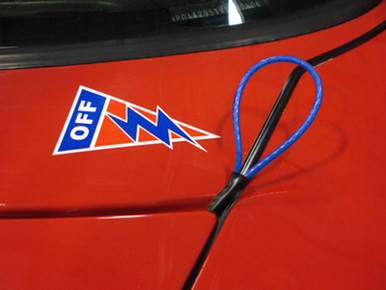
I mounted the actual switch next to me on the transmission tunnel, and then ran a very simple pull cable to the passenger side base of the windshield for corner workers.
I basically cloned what Prodrive had done on my Gruppe A car.
I can send pics if you are interested.Leave a comment:
-
I've seen them everywhere. The key is accessibility. Many Pro3 cars have them on the main hoop, passenger side. Our E28 it was on the tranny tunnel, and on my car it's in the passenger vent, though I really hate that location.
Sent from my iPhone using TapatalkLeave a comment:
-
I have previously seen a handle with a push bike cable attached to the external of the car that runs in and attaches to the kill switch.
The you can put it where ever you want for the marshals to pull and still have it in a good spot for the driver.
A google image search got me here that shows some nice photos of what i mean.
Leave a comment:

Leave a comment: