

I've never seen a dyno with these cams anywhere online. I just dyno'd mine so figured I'd post it up.
The engine:
1. Head was purchased from local racer, was built for endurance racing and had 30 hours on it when the engine cracked a piston (likely fueling related issue). Head has metric mechanic valves, dual spring valve springs. 275 degree cat cams.
2. Bottom end freshly rebuilt. Overbored 0.5mm using CP pistons with deep valve pockets. Pistons height was sized for a .01 thicker MLS gasket at 10.5:1 compression ratio but I decided I didn't want to deal with MLS so I'm running stock HG thickness. Probably like 10.7:1 compression or something along those lines.
3. Bottom end uses Kolbenschmidt rod/main bearings. Achilles oil pump. Rotating assembly was balanced. ARP rod bolts. ATI harmonic balancer. Redline set at 7400rpm with cut starting at 7200. Oil pump is loctited and safety wired, and a VW chain tensioner installed on the oil pump chain.
4. Link ECU
5. Stewart water pump with underdrive pulley. No AC. Lightweight flywheel.
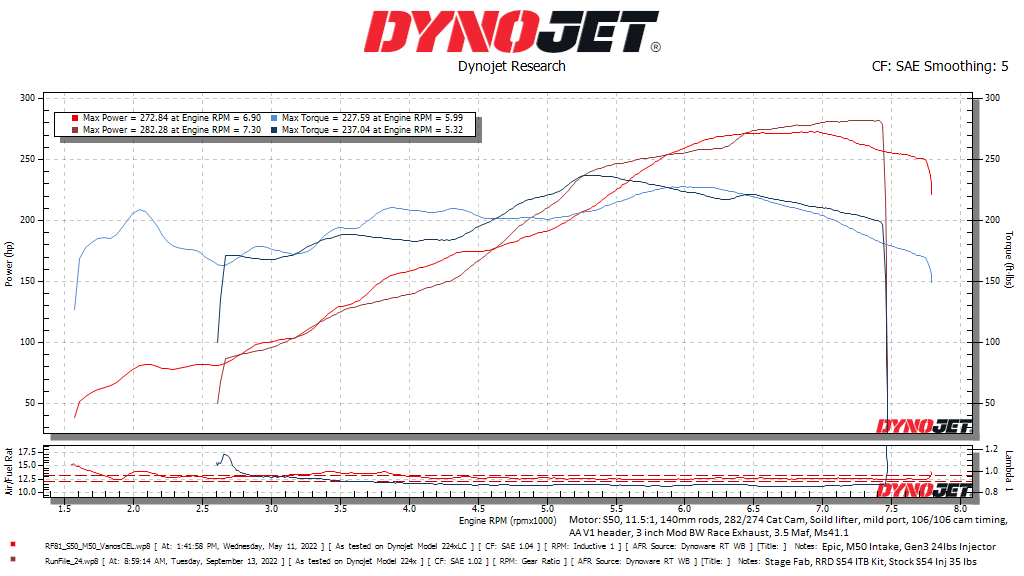
6. Engine is able to use full range of VANOS due to deeper valve reliefs. No vanos shimming/block needed. You can see the vanos switchover point on the dyno, I think the car would lose a lot of mid range power without vanos. These cams are huge.
7. Dyno wasn't taken up to redline unfortunately but you get the idea. Engine pulls very hard and sound amazing with the cams.
8. Engine would likely make more power with a better exhaust. Headers are supersprint knockoff headers purchased from ebay like ~16 years ago. The headers are merged immediately and go to a 2.5" single pipe done by a local exhaust shop years ago. Bends are not mandrel bent so actual pipe diameter effectively under 2.5 at all bend points. A 3" exhaust with bigger headers would likely open this up more.
9. Dyno is not SAE corrected. this is a dynojet. Peak HP 254 @ 6360 rpm, peak torque 229 ft/lbs at 4300.
10. Vanos switch point near 5200, you can see clearly on the graph when it is switched.
The torque increase as the cams come "on" around 2.5k is pretty extreme. Car does start up and idle fine with these cams (set at 1k idle). There is some cam surge below 2k RPM, tuner said this is normal with very big cams like this.
Purpose of this car is track days so I don't mind the poor low end power. Engine will be spending its time at high RPM's where it absolutely screams.

The engine:
1. Head was purchased from local racer, was built for endurance racing and had 30 hours on it when the engine cracked a piston (likely fueling related issue). Head has metric mechanic valves, dual spring valve springs. 275 degree cat cams.
2. Bottom end freshly rebuilt. Overbored 0.5mm using CP pistons with deep valve pockets. Pistons height was sized for a .01 thicker MLS gasket at 10.5:1 compression ratio but I decided I didn't want to deal with MLS so I'm running stock HG thickness. Probably like 10.7:1 compression or something along those lines.
3. Bottom end uses Kolbenschmidt rod/main bearings. Achilles oil pump. Rotating assembly was balanced. ARP rod bolts. ATI harmonic balancer. Redline set at 7400rpm with cut starting at 7200. Oil pump is loctited and safety wired, and a VW chain tensioner installed on the oil pump chain.
4. Link ECU
5. Stewart water pump with underdrive pulley. No AC. Lightweight flywheel.
6. Engine is able to use full range of VANOS due to deeper valve reliefs. No vanos shimming/block needed. You can see the vanos switchover point on the dyno, I think the car would lose a lot of mid range power without vanos. These cams are huge.
7. Dyno wasn't taken up to redline unfortunately but you get the idea. Engine pulls very hard and sound amazing with the cams.
8. Engine would likely make more power with a better exhaust. Headers are supersprint knockoff headers purchased from ebay like ~16 years ago. The headers are merged immediately and go to a 2.5" single pipe done by a local exhaust shop years ago. Bends are not mandrel bent so actual pipe diameter effectively under 2.5 at all bend points. A 3" exhaust with bigger headers would likely open this up more.
9. Dyno is not SAE corrected. this is a dynojet. Peak HP 254 @ 6360 rpm, peak torque 229 ft/lbs at 4300.
10. Vanos switch point near 5200, you can see clearly on the graph when it is switched.
The torque increase as the cams come "on" around 2.5k is pretty extreme. Car does start up and idle fine with these cams (set at 1k idle). There is some cam surge below 2k RPM, tuner said this is normal with very big cams like this.
Purpose of this car is track days so I don't mind the poor low end power. Engine will be spending its time at high RPM's where it absolutely screams.


Comment