-
If I want torque, I'll eat an apple. If I want HP, I'll eat an orange. Race cars can have 1,000hp and 250ft/lb torque that can reach speeds to circle the earth in seconds, while a Mack truck have 300hp with 1,500ft/lb torque can rotate the earth's axis a degree or two. I don't think it is a debate matter which is better, but rather what you want to achieve.Leave a comment:
-
you cant even read what i wrote and stop putting words into my mouth FFS. i am not talking about simply looking at PEAK hp numbers, i am talking about available/accessible hp which is from the entire hp curve and for that you need the car to be geared properly. if the engine is not operating at point of high hp then it is not "accessible". funnily enough that is why multi speed close ratio gearboxes exist so the engine operates at rpm where most work can be done.
obviously due to discrete ratios you cant always run the engine at the most optimum rpm so the power curve needs to have alot of area under it and gear ratios spaced correctly
a 900hp 250ft-lb F1 car would spank a 600hp 600lb-ft F1 car everyday of the week on the track. the 900hp car would be running more aggressive gearing and make use of torque multiplication so the torque in the axles would be higher. if driving on the street at low rpm the 600hp car would probably have more hp available depending on actual gear ratios
it is really simple
Power = force x velocity
so at a given velocity (I.e MPH) the force to accelerate (you know f=ma) depends on hp that is available at that speed.
maximizing the hp is the goalLast edited by digger; 03-27-2014, 12:19 PM.Leave a comment:
-
These threads always shine a light on who really knows their stuff (and those who don't).Leave a comment:
-
-
For daily driving torque, by my house there's decent sized hills, and I'm always having to downshift, don't really care, but would be nice just to power through in one gear.
If anybody knows SoCal, going up the 241 toll road I have to downshift to 4th then to 3rd, and just keep going back and forth between 3rd and 4th because I hate keeping it at 4 1/2 - 5k for too longLeave a comment:
-
"Fastest" is a subjective term though; it requires a bit of qualification. Do you mean fastest in a straight line up to vMax? Well then yeah, you would want maximum hp/torque high up in the rev range to allow maximum RPM. But what about on a road course? If you have an engine that lives only high up in the rev range that means you need more and closer gears to keep the engine where it works all the time, especially in slower/hairpin turns. Alternately, you could have an engine that produces more torque and therefore relatively more horsepower at a given lower RPM, and does not require as much shifting to allow the motor to work to its best advantage. This allows a smoother power delivery and less time shifting at corner entry and corner exit, and most likely a faster time through the corner all else being equal.Leave a comment:
-
The car with the most hp is fastest. Period.
Hp isn't an imaginary value - its a measure of ability to do work, like accelerate a vehicle. I think I'm repeating myself. ..Leave a comment:
-
I'm sorry but this is not all true :tsk:
It's not about maximum horsepower, it's about maximum torque and the ability for the car to do work. Max horsepower happens to occur when the car has a high amount of torque available, but that hp value is due to the torque available and the rpm where that torque is acting. But I do agree, the gear ratio will change the actual quickness you can accelerate.
In order to design an engine for a particular application, it is helpful to plot out the optimal power curve for that specific application, then from that design information, determine the torque curve which is required to produce the desired power curve. By evaluating the torque requirements against realistic BMEP values you can determine the reasonableness of the target power curve.
Typically, the torque peak will occur at a substantially lower RPM than the power peak. The reason is that, in general, the torque curve does not drop off (%-wise) as rapidly as the RPM is increasing (%-wise). For a race engine, it is often beneficial ( within the boundary conditions of the application ) to operate the engine well beyond the power peak, in order to produce the maximum average power within a required RPM band.
However, for an engine which operates in a relatively narrow RPM band, such as an aircraft engine, it is generally a requirement that the engine produce maximum power at the maximum RPM. That requires the torque peak to be fairly close to the maximum RPM. For an aircraft engine, you typically design the torque curve to peak at the normal cruise setting and stay flat up to maximum RPM. That positioning of the torque curve would allow the engine to produce significantly more power if it could operate at a higher RPM, but the goal is to optimize the performance within the operating range.
An example of that concept is shown Figure 3 below. The three dashed lines represent three different torque curves, each having exactly the same shape and torque values, but with the peak torque values located at different RPM values. The solid lines show the power produced by the torque curves of the same color.
Torque Curve 1
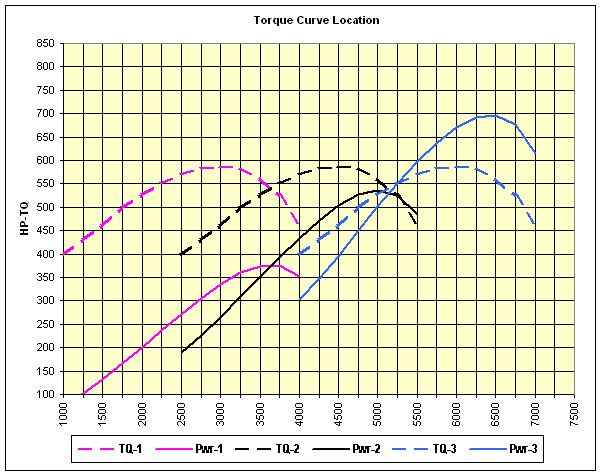
Figure 3
Note that, with a torque peak of 587 lb-ft at 3000 RPM, the pink power line peaks at about 375 HP between 3500 and 3750 RPM. With the same torque curve moved to the right by 1500 RPM (black, 587 lb-ft torque peak at 4500 RPM), the peak power jumps to about 535 HP at 5000 RPM. Again, moving the same torque curve to the right another 1500 RPM (blue, 587 lb-ft torque peak at 6000 RPM) causes the power to peak at about 696 HP at 6500 RPM
Using the black curves as an example, note that the engine produces 500 HP at both 4500 and 5400 RPM, which means the engine can do the same amount of work per unit time (power) at 4500 as it can at 5400. HOWEVER, it will burn less fuel to produce 450 HP at 4500 RPM than at 5400 RPM, because the parasitic power losses (power consumed to turn the crankshaft, reciprocating components, valvetrain) increases as the square of the crankshaft speed.
The RPM band within which the engine produces its peak torque is limited. You can tailor an engine to have a high peak torque with a very narrow band, or a lower peak torque value over a wider band. Those characteristics are usually dictated by the parameters of the application for which the engine is intended.
An example of that is shown in Figure 4 below. It is the same as the graph in Figure 3 (above), EXCEPT, the blue torque curve has been altered (as shown by the green line) so that it doesn’t drop off as quickly. Note how that causes the green power line to increase well beyond the torque peak. That sort of a change to the torque curve can be achieved by altering various key components, including (but not limited to) cam lobe profiles, cam lobe separation, intake and/or exhaust runner length, intake and/or exhaust runner cross section. Alterations intended to broaden the torque peak will inevitable reduce the peak torque value, but the desirability of a given change is determined by the application.
Torque Curve 2
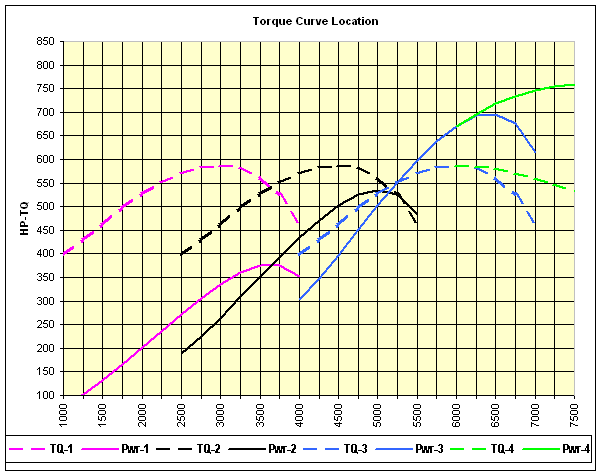 HP = TORQUE x RPM ÷ 5252
On the charts, think of the PINK like a Muscle car V8-- lots of torque at low rpm. Then notice that the torque of all 2 graphs is THE EXACT SAME, besides RPM.
Also note that every plotted curve that reaches ~5000rpm, note that each HP curve crosses the torque curve at exactly 5252rpm (where did that number come from?? See equation above!) Remap that graph with more of the same torque curves, and the resulting HP curves will continue to rise due to the formula that defines HP.
But notice, the resulting HP values tell you that the BLUE vehicle has the most HP. Is the BLUE vehicle better/more powerful/faster? That depends-- high horsepower (which comes from torque at a higher rpm) means that the car will probably pull quicker as you get higher in the revs. Vise versa, on the same toque value in the lower rpms, the car will probably get off the line quicker...
AKA, torque is a measured quantity, but HP is a calculated value used to compare engines/torque values.Last edited by tschultz; 03-27-2014, 05:23 AM.Leave a comment:
-
horsepower is torque, bro.
What you're really asking is low end power vs high end power
Why restrict yourself. Go for both.Leave a comment:
-
DD = better low-mid end, higher torque (yeah, I said it!)
Race car = generally better top end, higher HP, although there is a lot to say for a fatter midrange as well especially on tracks without long straights.
In other news, math and physics are made up and all that matters is how good your exhaust sounds.Leave a comment:
-
you only need to think about what you do when you are travelling at say 60mph and need to quickly overtake someone. you change to a lower gear to get more hp. the close you get to peak hp the quicker you will accelerate. you are operating at a point on the engine rpm with lower engine torque but you have better gear ratio hence you torque at the axles is still higher.
it is hp, proper gearing and tractionLeave a comment:


Leave a comment: