Swap 1/4 Mile Thread

Collapse
X
 
  • Time
  • Show
Clear All
new posts

  • digger
    replied
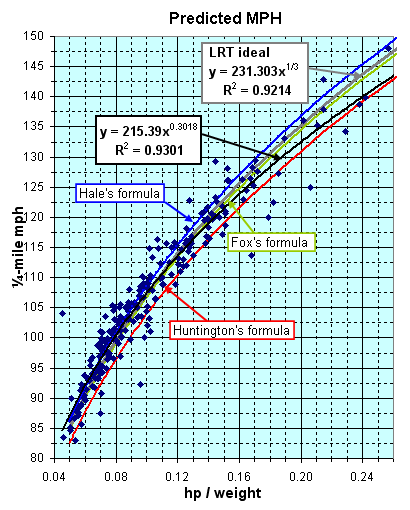
    you guys should use this calculator(s) in this link (ones near bottom)

    roger huntington, earles mccaul, geoffrey fox, patrick hale, drag race, elapsed time, e.t., et, performance, power, formula, horsepower, weight, fot rod, rod custom, road track, drag strip dyno, quarter jr, trap speed, road test, power factor, power equation, 1/4 mile, lrt, drag racing, jeff lucius, lucius, car, mitsubishi, dodge, 3000gt, stealth, dodge stealth, dodge stealth r/t, dodge stealth r/t twin turbo, dodge stealth r/t tt, stealth316.com, stealth 316, stealth316, mitsubishi 3000gt, mitsubishi 3000gt vr4, vr4, r/t, tt, technical


    what it shows that a stock weight 3000lb car (as tested i.e. inc driver) will trap 100mph with a stock S50

    it is really only good for hp/weight to give trap speed and vice versa there are not enough variables to predict ET with any degree of confidence

    P.S don't use this calculator if you have dynojet numbers because it will be a reality check........;)

    Leave a comment:


  • eurosport22
    replied
    S50 with schricks, 24lb injectors, 3.5 maf, TRM tune
    zf260 2.93 rear end
    street tires leaving the line at 3,000 rpm letting the clutch out slightly hard
    r/t .251 (haha zzzzzzz)
    60`2.053
    1/8 8.72
    1/4 13.557
    mph 103.78

    Leave a comment:


  • rneedham1979
    replied
    All you NA guy need to throw on a turbo. Even a cheap, low hp set up. The FI'd E30 is super fun car.

    Leave a comment:


  • evandael
    replied
    slight thread jack ahoy!

    an earlier post mentioned proper suspension setup is key for traction/times.. saying something about rear suspensions that are too stiffly sprung.


    what would be an ideal spring rate combo front/rear for good traction with an S52? let's say the car is running sticky 225's or similarly appropriate tires.

    Leave a comment:


  • DREWHALL
    replied
    Edited my post. I was at MIR for that run. I was using some beat 205/50/15 ET Streets but I was wheel hopping really bad so I didn't get them as warm as they should have been. It has surprised me so far haha.

    Leave a comment:


  • JGood
    replied
    Originally posted by DREWHALL
    It is an OBD1 S50. I got it from Mike(white325is) who said it came out of a wrecked e36 328 in a junkyard somewhere. He had a couple dyno sheets of 250-260 at the wheels but one was a dynojet. I'm running a G260 trans with 3.73LSD. The car is ~2565 with a little over a 1/4 tank so its pretty light. I was thinking the M60 would be faster than that. I really don't know what is done to this engine honestly, this winter I want to pull the head and do a gasket and studs and see what is really inside. I want to measure the cams compared to stock and see what I am working with. It is a pretty quick car.

    Did you do that run at Cecil?

    I remember seeing Mikes dyno, that is a strong engine.

    I walk away from my buddies OBD-I s52 e30, from any speed in any gear. Our cars are geared identically (trans and diff). That's why I was surprised you trapped 2-3mph faster then me. Just doesn't add up!


    Originally posted by justin_l_
    I honestly think your car has alot left in it. Should be low 13's high 12's with your setup. I'm still picking away at my roomate's S52 setup, but am curious as to what it will pull at the track. I'm hoping to see high 12's low 13's if he lets me do a few runs.

    I had my NV down to 13.9 at 100 for reference.
    Not saying my car couldn't do a faster 1/4 mile pass, but I didn't have much wheel spin on that run. Dropping 2 tenths on the 60' would take me down to a 13.2 or so, but that's all she's got I think. The trap speed can't really go up.

    I remember your NV m50 run, and questioning it at the time haha. My cammed m50 car trapped 96mph. Trap speed has almost nothing to do with the driver, it just tells the power/weight story. You gained 4mph with less hp then me. Crazy.


    I'm starting to think the track has a good bit to do with it. Like I said, my buddy took his car to Maple Grove and ran a 15.5, but at Cecil he ran a 14.7. If that holds true for me too, I'd be in the high 12's with a 2.0 60'.

    Leave a comment:


  • DREWHALL
    replied
    Originally posted by JGood
    What engine do you have, and what mods? Did you run at Cecil?

    I ran a 13.6@103 with a 2.0 60', and I have an m60b40 (~260 whp and tq), weighing 2685.

    Not making excuses for my car or saying you didn't run what you did, but something isn't adding up here if you're just running an s52 haha. I heard Cecil is a fast track, my buddy ran a 14.7 there, and runs ~15.5 at Maple Grove, which is where I did my 13.6.
    It is an OBD1 S50. I got it from Mike(white325is) who said it came out of a wrecked e36 328 in a junkyard somewhere. He had a couple dyno sheets of 250-260 at the wheels but one was a dynojet. I'm running a G260 trans with 3.73LSD. The car is ~2565 with a little over a 1/4 tank so its pretty light. I was thinking the M60 would be faster than that. I really don't know what is done to this engine honestly, this winter I want to pull the head and do a gasket and studs and see what is really inside. I want to measure the cams compared to stock and see what I am working with. It is a pretty quick car.

    Edit: Ran at MIR. It's like 5 miles from my house.
    Last edited by DREWHALL; 11-12-2012, 05:12 AM.

    Leave a comment:


  • justin_l_
    replied
    Originally posted by JGood
    What engine do you have, and what mods? Did you run at Cecil?

    I ran a 13.6@103 with a 2.0 60', and I have an m60b40 (~260 whp and tq), weighing 2685.

    Not making excuses for my car or saying you didn't run what you did, but something isn't adding up here if you're just running an s52 haha. I heard Cecil is a fast track, my buddy ran a 14.7 there, and runs ~15.5 at Maple Grove, which is where I did my 13.6.
    I honestly think your car has alot left in it. Should be low 13's high 12's with your setup. I'm still picking away at my roomate's S52 setup, but am curious as to what it will pull at the track. I'm hoping to see high 12's low 13's if he lets me do a few runs.

    I had my NV down to 13.9 at 100 for reference.

    Leave a comment:


  • red_e30
    replied
    i have an obd1 swapped m52 with m3 cams ported head pink top injectors and chip
    dynoed on a dyno jet 194 hp and 178 tq
    ran a 14.7 kinda slow hoped for faster time but dont have much experience

    Leave a comment:


  • JGood
    replied
    Originally posted by DREWHALL
    Well I just ran. First time running this car, only ran FWD cars a few times before this. 13.4@ 105 with a 2.1 60 ft. It just spun through second, tried lifting but kept spinning. Car is 2715 with me in it, I'm about 155. I ran against a new Camaro that ran 12.7 at 106, once I stopped spinning he wasn't going anywhere. There is definitely more in this thing, just need to learn how to drive. :D

    What engine do you have, and what mods? Did you run at Cecil?

    I ran a 13.6@103 with a 2.0 60', and I have an m60b40 (~260 whp and tq), weighing 2685.

    Not making excuses for my car or saying you didn't run what you did, but something isn't adding up here if you're just running an s52 haha. I heard Cecil is a fast track, my buddy ran a 14.7 there, and runs ~15.5 at Maple Grove, which is where I did my 13.6.

    Leave a comment:


  • rneedham1979
    replied
    Originally posted by DREWHALL
    Well I just ran. First time running this car, only ran FWD cars a few times before this. 13.4@ 105 with a 2.1 60 ft. It just spun through second, tried lifting but kept spinning. Car is 2715 with me in it, I'm about 155. I ran against a new Camaro that ran 12.7 at 106, once I stopped spinning he wasn't going anywhere. There is definitely more in this thing, just need to learn how to drive. :D
    Nice man, you'll get it down. With a really good 60ft you'd break into the 12's.

    Leave a comment:


  • DREWHALL
    replied
    Well I just ran. First time running this car, only ran FWD cars a few times before this. 13.4@ 105 with a 2.1 60 ft. It just spun through second, tried lifting but kept spinning. Car is 2715 with me in it, I'm about 155. I ran against a new Camaro that ran 12.7 at 106, once I stopped spinning he wasn't going anywhere. There is definitely more in this thing, just need to learn how to drive. :D

    Leave a comment:


  • Adrian_Visser
    replied
    This should really be here for posterity:

    Originally posted by leothedrummer
    Taken from another forum:

    Since you asked so nicely, here are my thoughts. I've assumed the following:

    + Street radial tyres
    + Pump fuel

    Setup For Drag Racing - Weight Reduction
    First setup you car before going to the strip.

    Your first task is weight reduction. Ensure you get to the strip with 1/8th tank of fuel. That means allowing enough fuel to get there with 1/8th left. Better to arrive with too little fuel and then topping it up a tad from your jerry can, which is of course filled with the same 98 RON fuel you have in your tank. A properly mixed slug of octane booster will give you some peace of mind too. Remember to put the booster in first to allow the petrol to mix with it properly in the tank.

    Every 1 litre of fuel weighs 640 g.

    Next drain all the water out of your washer botle. My M Coupe takes 5 litres in the washer bottle which is 5 kgs you don't need.

    Then remove the spare tyre, toolkits and anything else from your boot and from inside your car. Anything that can be eaily removed should go (CD Stackers, carpets, lose stuff, etc).

    Now decide if you want to go to the trouble of removing your rear seats and passenger seat. Believe me when I tell you it will make a big difference. On average they say every 100 lbs (~45 kgs) is a tenth (0.1 off your ET).


    Setup At The Strip - Tyre Pressures
    Now you've driven to the strip and been through scrutineering, get out your trusty pass journal and tyre pressure gauge.

    Ensure you've got 1/8th tank of fuel - you don't want to starve for fuel during a pass. Now hook up your compressor and increase your front tyres to 55 psi. If you don't have access to a compressor then swing by the closest servo to your drag strip and do this before you lob at the strip.

    You increase the pressure in your front tyres to minimise rolling resistance. If you happened to have an alternate set of narrower wheels/tyres then you'd fit the narrowest practical set for race day.

    The rear tyre pressure is more involved, because you've got to try a range of pressures and see what results in the best 60' times. The optimum setting changes as the weather conditions change, so this is a bit of a black art. That's what your Pass Journal is all about. This is where you record your car setup and the results after each run. That way you can make changes one at a time and make some sort of analysis in order to optimise your setup.

    Generally speaking you should drop your rear tyre pressure 4 psi from standard and then work your way down by half a psi at a time until your 60' times get worse.

    Remember that fine adjustments on street radials is less of a factor than when you graduate to drag radials or slicks. However it is still well worth your while to get close to the optimium.

    Your Pass Journal will have an entry for every pass you do, including the following information as a minimum:

    + Tyre pressure
    + Launch RPM
    + 60' result
    + My comments

    More on how to use your Pass Journal seek the optimum setup in a later post.


    The Burnout - How Long?
    If you are a beginner or feel a bit nervous about the upcoming pass, then simply drive around or through the water box and don't worry about a burnout. You can add the burnout to your later passes as you become more comfortable.

    Remember that street cars using street radials are very different to a Top Doorslammer. You're not going to do a half track burnout and wow the crowd. Street cars that do long pointless burnouts are basically wasting everyone's time. Don't be one of them!

    Now street radials like a touch of heat in them to get optimum traction. But too much heat and their traction is reduced. However if you don't spin the tyres at all then you've still got some water and grit on your tyres from the water box (unless you managed to drive around it).

    My advice for street radials is to drive through the water box and come to a halt. When signalled by the official, dial up the revs and drop the clutch. Wait until your tyres smoke a tad and then button off. We're talking less than a 2 second burnout here. More than that and you risk cooking the rubber (ie reducing traction until they cool).

    Realise that drag radials and slicks are made totally differently to street radials. These special tyres require a lot more heat to work. Street radials don't.


    The Burnout - How To Do One?
    Now you know how long to let the burnout go for, exactly how do you perform a decent burnout?

    Let's start from standstill, waiting for the official to motion you to start your burnout. Select the appropriate gear (1st, 2nd or 3rd depending on your horsepower, the higher the gear the more power required to turn the tyres over). When the official signals to start your burnout, dial in some revs and drop the clutch. You can dance your left foot over to touch the brake a tad and balance the revs via throttle with forward movement via brake (takes a bit of practice).

    Now if you continue to creep forward and start to contact your tyres with dry sticky track then you're obviously going to put more strain on your driveline.

    When you've got some heat into the tyres, just let off the brake and /or drop revs a tad and your car will creep forward. Get off the gas and allow the car to roll gently towards the staging lights.


    How To Pre-Stage
    You're rolling gently towards the staging lights. Keep your eyes on the Christmas Tree and look for the White Pre-Stage light to blink on. The instant you see this light come on you nail the brakes and come to a total halt. You're not yet fully staged - just pre-staged. The second Full Stage light is still unlit.

    I recommend you now wait until your opponent is at least Pre-Staged or even on Full Stage before you bump in to Full Stage. Once either compeitor is on Full Stage, the other racer has only 20 seconds to fully stage or the starter may disqualify you. In practice at a street meet the starter will rarely disqualify you, but they may come over and bang on your side window to hint that you're holding things up!

    Once you are pre-staged you must now focus on that Full Stage light with all your concentration. Because as soon as you fully stage, the starter can trigger the Christmas Tree at any time.


    How To Bump On To Full Stage
    You're at a halt with the Pre-Stage light up and your competitor is fully staged.

    Now apply your handbrake gently and dial up your pre-determined launch RPMs. You've already thought about what RPM you're going to launch at before you lined up. If this is your first pass, then just choose whatever starting point you think appropriate.

    Your clutch is in, your RPMs are steady at your launch point and your handbrake is slightly on. Now you ever so gently tease your clutch out - looking for the friction point where the RPMs start to dip showing you the clutch is dragging you your engine just slightly.

    With your left hand you are holding the handbrake just slightly on. This is a delicate balancing act, ensuring your engine is at launch RPMs, your car rolls forward ever so slightly and your rear brakes are just slightly on to ensure you move very very slowly on to Full Stage.

    This is called bumping on to Full Stage and is not easy to do. If you roll forward too far you will Redlight by crossing over the start beam. No big deal, it's all practice and you'll do better next time.

    Once you bump on to Full Stage you pull your handbrake up firm so your car comes to a dead stop. But you don't allow the handbrake to ratchet on lock, you keep it on but not locked by pressing the button as you hold it.

    If you get it right you will find yourself fully staged, motionless on the start line and most importantly, you are solidly locked on your launch RPMs with your clutch just at friction point, dragging against your handbrake.

    You are not looking at your tacho to check your RPMs. You are not looking at your handbrake. You are not looking at anything other than the Christmas tree.


    The Launch
    It's been covered in detail in many other places so I'll just state it here. Because of human reaction time and because of the vehicle reaction time of your car's suspension and drivetrain, you do not launch when you see the Green light on the Christmas Tree. You launch the instant you see the last of the three Amber lights come on.

    You're at steady launch RPMs with the clutch at friction point and the handbrake held on but not locked. As you see the last Amber come on, you release the handbrake fully (holding the button in), progressively mash the throttle and modulate your drivetrain using your clutch.

    This is not easy to do and takes many repetitions to get a good result. This is where it's all at - your reaction time versus your opponent and how well you can launch your car without wheelspinning.

    You must slip your clutch mercilessly to get an optimum launch. Sometimes you may find you have not let the clutch out fully before it is time to change up a gear. This is OK.

    Wheelspin on launch or upshift will cost you precious time. The optimum launch is at 10% wheelspin. This is very difficult to achieve and again comes only with much practice and experience. It's all good!

    Yes, you will punish your clutch. Yes, it will give off that awful smell of tortured components. Yes - it is the only way to optimise your launch.

    Clutches are consumables and are meant to be replaced. Regular drag racing will severely shorten the life of your clutch, but so what? You replace the clutch and go on your way. Just like tyres.


    Getting A Better Time
    Your reaction time (RT) is all about how quickly you react on the start line. It does not factor into your ET at all. However the winner of each race is very much affected by the RT. So once you are comfortable with the process of doing the burnout, launching and shifting up through the gears I recommend you treat each pass like it's a race. The only way to get better is to practice like you race.

    Drag racing is all in the launch. Every tenth (0.1 second) reduction in your 60' time is .15 to .25 reduction in your ET.

    You can beat an opponent with a much more powerful car by getting a sharp RT and by getting a sweet launch.


    That will do for now, happy to answer any specific questions or prate on about any area in more detail if desired.


    HTH

    Leave a comment:


  • MacBudd541
    replied
    Originally posted by Wh33lhop
    13 flat is QUICK. That's E39 M5 quick.

    How'd it hook? Any traction issues?
    It hooked up suprisingly well. much better than it does on the street. I couldnt dump the clutch or anything but I also didnt really have to feather the throttle. I do have a sub box from Luke in the trunk to help with traction and hurt my trap ;).

    -Mac

    Leave a comment:


  • Wh33lhop
    replied
    13 flat is QUICK. That's E39 M5 quick.

    How'd it hook? Any traction issues?

    Leave a comment:

Working...