
The long-awaited moment is approaching. The bumpers will look very stylish on the beautiful blue car. Great job, the bumpers look great. The protective polish you used is very sensible; corrosion is the biggest enemy of these cars. I'm eagerly waiting :) :)
-
-
Assembly_197. ETK_51_Front bumper (part 1)
Finally, it's time to install the bumpers. I'll start with the front one.
Front bumper


Part #1 - middle front bumper (51 11 1 888 265) - standard chrome bumper.
But in my case it is now - primed middle front bumper (51 11 1 959 911) - optional bumper for painting in body color. Used with the option "S339 Shadow Line equipment kit".
Part No. 2 - left front bumper (51 11 1 888 391) - standard chrome bumper.
But in my case it is now - primed left front bumper (51 11 1 959 907) - optional bumper for painting in body color. Used with the option "S339 Shadow Line equipment kit".
Part No. 3 - right front bumper (51 11 1 888 392) - standard chrome bumper.
But in my case it is now - primed bumper right front (51 11 1 959 908) - optional bumper for painting in body color. Used with the option "S339 Shadow Line equipment kit".
Part No. 4 - left trim (51 11 1 888 269) - for the standard chrome bumper.
But in my case it is now - primed left trim (51 11 1 959 887) - optional trim for painting in body color. Used with the option "S339 Shadow Line equipment kit".
Part No. 5 - right trim (51 11 1 888 270) - for the standard chrome bumper.
But in my case it is now - primed right trim (51 11 1 959 888) - optional trim for painting in body color. Used with the option "S339 Shadow Line Equipment Kit".


Part No. 6 - screw (51 12 1 843 029) - 4 pcs. Flat head screw for square hole. I bought similar M8x25 screws at a hardware store. For assembling bumper parts.
Part No. 7 - nut with washer M8 (51 11 7 070 183) - 6 pcs. For assembling bumper parts and attaching them to brackets.
Part No. 8 - leaf nut ST4,8-13-ZNS3 (07 12 9 904 223) - 2 pcs. For fastening pads No. 4, No. 5.
Part No. 9 - self-tapping screw ST4,8X13-Z2 (07 11 9 907 957) - 2 pcs. For fastening pads No. 4, No. 5.

Part No. 10 - protective strip (51 11 1 888 266) - 1 pc. Central plastic plate for the license plate. For the M-Technic I body kit, a plate (51 11 1 953 715) is used, which compensates for the gap from the apron.
Part No. 11 - left protective strip (51 11 1 888 273) - 1 pc. Left plastic trim. For the M-Technic I body kit, a trim (51 11 1 953 713) is used, which compensates for the gap from the apron, and does not have a lower protrusion on its extreme end.
Part No. 12 - right protective strip (51 11 1 888 274) - 1 pc. Right plastic trim. For the M-Technic I body kit, a trim (51 11 1 953 714) is used, which compensates for the gap from the apron, and does not have a lower protrusion on its extreme end.
Part No. 13 - strip clamp (51 11 1 838 076) - 8 pcs. Clips for attaching the strips. For the M-Technic I body kit, a threaded clamping screw (51 11 1 919 151) - 6 pcs. and M6 nuts (07 14 7 134 319) - 6 pcs.

Part No. 14 - bracket (51 11 1 888 122) - 2 pcs. Brackets for attaching the bumper to the body.
Part No. 15 - bolt M8X16-8.8-ZNS3 (07 11 9 902 900) - 4 pcs. Fastening the brackets to the body. The ETK also indicates M6x16 bolts, but this is probably another mistake.

Part No. 16 - self-tapping screw ST6,3X22-C-Z2 (07 11 9 916 971) - 2 pcs. For attaching the bumper on the sides.
Part No. 17 - protective cover (51 11 1 888 293) - 2 pcs. Plastic plug for attaching the bumper to the brackets.
Part No. 18 - leaf nut ST6,3 (51 11 1 900 386) - 2 pcs. For attaching the bumper on the sides.

Part No. 19-22 - not used. These are side panels consisting of two separate parts. They were used on the earliest cars.
Part No. 23 - a set of fastening elements ( 51 11 9 057 083). A complete set of fastening elements for assembling and installing the front bumper, including parts No. 6 - No. 9, No. 13-No. 18. Unfortunately, it is no longer available for order.
In the photo from the Internet, there are even clips for attaching the license plate and some other unnecessary elements.

So, first we screw the bumper brackets to the side members. Two M8 bolts on each side.

The bracket is placed in this position - with the straight side up, and the beveled side down.

Installed. They do not require any position adjustments. The size of the holes on the bumper is sufficient for this.

Now we start assembling the bumper itself.
We fasten the side parts to the bumper - 2 bolts and M8 nuts each.

Since I am not using the original bolts, I had to cut off the cap a little on the two upper bolts so that it would not interfere with installing the pads later.

The rounded cap on the front two bolts does not interfere.

We do not tighten the nuts immediately. We try on the bumper, adjust the angles of the side parts in relation to the body.


After that, we carefully remove the bumper and tighten all four nuts. We install the mounting plate for attaching the pads.

We put the cover on the bumper and screw it in with a self-tapping screw.


Done.

The cover is good, the sawn-off bolt head does not interfere.

There are some more holes on the side parts of the bumper, but I don’t understand what they are for. There are no corresponding holes in the central part, so they are not used.

We install special mounting plates with a plastic spacer on the sides of the bumper and self-tapping screws for fastening.


The metal parts are assembled. Now you need to install the plastic linings. They are attached using metal clips. To make the clips hold better in the linings and press them, I glued splen gaskets to them.

We insert two clips into the side linings and four clips into the central lining. In the central lining, they are initially placed only at the edges. The two clips under the license plate are inserted after the lining is installed on the bumper.

We snap the clips into the holes in the bumper. The clips are not new, they have lost a little elasticity, so some of them had to be pulled out from the inside to lock them in place.

Two clips on the sides. You need to make sure that the plastic guides also fall into the corresponding holes on the bumper.

You also need to carefully hook the upper part of the trim with a special hook to the edge of the bumper. Often it is already broken.

By the way, when installing the M-Technic I body kit, it is not necessary to install other M-Technic I side panels. According to the EBA factory instructions, it is allowed to simply cut the lower protrusions at the extreme ends of the side panels.
Now we snap the two central clips - from the outside, right through the panel.

The plastic panels are installed.

As I wrote above, to attach the plastic overlays, you can use the original M-Technic I body kit mount, which is a metal mounting plate with an M6 threaded stud, which is pressed from the inside with an M6 nut. This will be easier, more reliable and faster. You will need 6 pieces in total. The central mount under the license plate remains on two standard metal clips.
The front turn signal housing is also part of the bumper overlays. We insert them from the outside, align all the overlays and press them, screwing the turn signals with two self-tapping screws.


The front bumper is assembled. Only two plugs remain to be installed after it is installed on the car.

The bumper is ready for installation.

Comment
-
Assembly_197. ETK_51_Front bumper (part 2)
So, let's start installing the front bumper.
Connect the connectors of the front turn signals and check if they work properly. It's better to do this right away, because then you won't be able to get to these connectors without removing the bumper.
Put the bumper on the studs of the brackets and fix them with nuts, without tightening them.
To secure the bumper on the sides, you need to remove the plastic shields in the wheel arch. That's why I didn't screw them in these places when I installed the lower protective shield.

Lower the shield down and unscrew the front part of the wheel arch shield and gain access to the side bumper mount.

Align the bumper and screw the self-tapping screw into the mounting plate installed on the bumper.


Now I can fully secure the protective shields. Two mounting plates on the lower edge of the wheel arch.

And one mounting plate on the lower protective shield.

We tighten three self-tapping screws and one plastic nut on the spar.

Similarly on the right side.


The wheel arches are completely closed.
Now tighten the front nuts on the bumper brackets and close them with plugs.

The arrows on the plugs show "top". This is the position in which they should be installed.

In this case, it will be very easy to remove them through a special hole under them - by pressing a screwdriver from the middle on the "ear" of the plug.

And you won't need to pry them from the front, as most do.
So, the front bumper is installed.


Maybe not ideal, but I like it! )

In my opinion, a body-colored bumper looks much nicer than a completely black bumper.

Cute face! )Comment
-
Assembly_198. ETK_51_Rear bumper (part 1)
Installing the rear bumper.
Rear bumper


Part #1 - middle rear bumper (51 12 1 888 276) - standard chrome bumper.
But in my case it is now - primed middle rear bumper (51 12 1 959 914) - optional bumper for painting in body color. Used with the option "S339 Shadow Line equipment kit".
Part No. 2 - left rear bumper (51 12 1 922 161) - standard chrome bumper.
But in my case it is now - primed left rear bumper (51 12 1 959 901) - optional bumper for painting in body color. Used with the option "S339 Shadow Line equipment kit".
Part No. 3 - right rear bumper (51 12 1 922 162) - standard chrome bumper.
But in my case it is now - primed right rear bumper (51 11 1 959 902) - optional bumper for painting in body color. Used with the option "S339 Shadow Line equipment kit".
Part No. 4 - left trim (51 12 1 888 283) - for the standard chrome bumper.
But in my case it is now - primed left trim (51 12 1 959 895) - optional trim for painting in body color. Used with the option "S339 Shadow Line equipment kit".
Part No. 5 - right trim (51 12 1 888 284) - for the standard chrome bumper.
But in my case it is now - primed right trim (51 12 1 959 896) - optional trim for painting in body color. Used with the option "S339 Shadow Line Equipment Kit".


Part No. 6 - screw (51 12 1 843 029) - 6 pcs. Flat head screw for square hole. I bought similar M8x25 screws at a hardware store. For assembling bumper parts and attaching them to brackets.
Part No. 7 - nut with washer M8 (51 11 7 070 183) - 8 pcs. For assembling bumper parts and attaching them to brackets. The ETK indicates 6 pcs. - this is a mistake.

Part No. 8 - protective strip (51 12 1 888 286) - 1 pc. Central plastic overlay. For the M-Technic I body kit, an overlay (51 12 1 953 890) is used, which compensates for the gap from the apron.

Part No. 9 - strip clamp (51 11 1 867 927) - 15 pcs. Clips for fixing the strip. For the M-Technic I body kit, a threaded clamping screw (51 12 1 932 230) - 15 pcs. and M6 nuts (07 14 7 134 319) - 15 pcs.
Part No. 10 - rubber washer (51 12 1 886 299) - 4 pcs.
Part No. 11 - M6 nut (07 14 7 134 319) - 2 pcs. The ETK indicates 6 pcs. - this is an error.
Part No. 12 - bracket (51 12 1 916 597) - 2 pcs. Brackets for attaching the bumper to the body.

Part No. 13 - left locking element (51 12 1 888 287) - 1 pc. Left plastic end cap. For the M-Technic I body kit, a cap (51 12 1 953 711) is used, which does not have a lower protrusion on its extreme end.
Part No. 14 - right locking element (51 12 1 888 288) - 1 pc. right plastic end cap. For the M-Technic I body kit, a cap (51 12 1 953 712) is used, which does not have a lower protrusion on its extreme end.

Part No. 15 - leaf nut ST6.3 (51 11 1 900 386) - 2 pcs. For attaching the bumper on the sides.
Part No. 16 - self-tapping screw ST6.3X22-C-Z2 (07 11 9 916 971) - 2 pcs. For attaching the bumper on the sides.
Part No. 17 - self-tapping screw ST6.3X32-C-Z1 (07 11 9 916 975) - 2 pcs. For attaching the end caps to the body. There is probably also a mistake here - a self-tapping screw 32 mm long will go through this cap. Therefore, I use self-tapping screws No. 16 and No. 17 vice versa.
Part No. 18 - hose 8X13X80 (16 12 1 176 779) - 1 pc. This is some very mysterious, and incomprehensible part. I can't imagine where in the bumper mount you can use a piece of fuel hose.... If anyone knows - I will be grateful for the information. Perhaps this is also some kind of mistake, or they meant some rubber gaskets for self-tapping screws...
Part No. 19 - shield (51 12 1 911 293) - 2 pcs. This is a decorative plastic cap for the upper M6 nuts securing the bumper brackets to the body. The ETK indicates 4 of them - this is a mistake, because the lower studs of the brackets have an M8 thread, so they won't fit there.
Part No. 21...№25 - I also don't understand the details. Perhaps they were used on some early versions instead of parts #17, #18. Again, #23 is indicated as a fuel hose... There are some holes on the bumper at the edges, perhaps the end plates were attached with these M6 bolts and nuts. In my case, there is no place to use them.
Part No. 26 - set of fastening elements (51 12 9 057 084). A complete set of fastening elements for assembling and installing the rear bumper, including parts No. 6 - No. 7, No. 9-No. 11, No. 15-No. 19. Unfortunately, it is no longer available for order.
In the photo from the Internet, there are even some extra elements.

The procedure for assembling and installing the rear bumper is different from the front.
We begin to assemble the bumper itself.
We fasten the side parts to the bumper - 2 bolts and M8 nuts each.

Since I'm not using original bolts, I had to cut off the cap a little on the two upper bolts so that it wouldn't interfere with installing the pads. The pads are screwed on at the same time, with the same front bolts. The rounded cap on the front two bolts doesn't interfere. I also used washers.

We don't tighten the nuts right away. We try on the bumper, adjust the angles of the side parts relative to the body. After that, we carefully remove the bumper and tighten all four nuts.
Done. The pad is good, the sawn-off bolt head doesn't interfere.

Now we screw the brackets to the bumper. According to ETK, similar bolts and nuts M8 are used for this. But, in my case, the previous owner welded these bolts to the bumper. In my opinion, it is even much more convenient.

We screw the brackets in this position. As you can see in the photo - the upper stud has an M6 thread, and the lower one - M8. Accordingly. and the nuts are different. Therefore, decorative plastic caps fit only on the upper M6 nuts.


There are some more holes on the side parts of the bumper, but I don't understand what they are for. There are no corresponding holes in the central part, so they are not used.

We install special mounting plates with a plastic spacer on the sides of the bumper and self-tapping screws for fastening.

The metal parts are assembled.

Now you need to install the plastic pads. They are attached using metal clips. To make the clips hold better in the pads and press them, I glued splenic pads to them.

Insert the clips into the pad, turning them 90 degrees into the groove of the pad.

Place them opposite the holes in the bumper.

In the middle part of the bumper there are 7 pieces.

In the side parts of the bumper there are 4 pieces on each side.


Align the middle of the lining in the middle of the bumper, so that there is enough length of the lining on both ends. Start snapping the clips from the center to the edges.

The clips are not new, they have lost a little elasticity, so some of them had to be pulled out from the inside to fix them.

We insert the end pads into the grooves, snap them into special holes, pressing them against the central pad. You also need to carefully hook the upper part of the pad with a special hook to the edge of the bumper. Often it is already broken.

By the way, when installing the M-Technic I body kit, it is not necessary to install other M-Technic I end caps. According to the EBA factory instructions, it is allowed to simply trim the lower protrusions on the extreme ends of the caps.
The plastic caps are installed.

As I wrote above, to attach the plastic caps, you can use the original M-Technic I body kit mount, which is a metal mounting plate with an M6 threaded stud, which is pressed from the inside with an M6 nut. This will be easier, more reliable and faster. A total of 15 pieces are required.
The front bumper is assembled and ready for installation.


Comment
-
Assembly_198. ETK_51_Rear bumper (part 2)
So, let's start installing the rear bumper. To do this, you need to remove the rear panel trim in the trunk. Also, for convenience, it is better to remove the battery (if it is installed in the trunk).

The rear bumper is more difficult to install than the front one, due to its large side parts - you can scratch the rear wings or apron. In addition, it is not very easy to get all four pins into the corresponding holes in the body at once. Therefore, it is better to do this together, with an assistant.
The brackets should not be fully tightened so that they can be adjusted using the holes in the body. Insert the bracket pins into the holes and adjust the position of the bumper. Carefully remove the bumper, and in this position tighten the nuts of the brackets without moving them. Now you can install the bumper and secure it with four nuts.
Two nuts with M6 washers in the trunk, above the floor. Under the nut, install a rubber sealing washer to prevent water from entering the trunk.

We install plastic caps on the nuts.

Similarly on the right side.
Two nuts with M8 washers on the rear spars, under the trunk floor.

Similarly on the right side.
To secure the bumper on the sides, you need to screw two self-tapping screws into the trunk through special holes in the rear wings. Under the self-tapping screw, install a rubber sealing washer to prevent water from entering the trunk. There is a special cutout in the trim for this. Align the side parts of the bumper and screw it into the mounting plates with self-tapping screws.

On the right side, similarly, only in my case, for better access, you need to remove the battery. The trim does not cover this place.
On the inside of both wheel arches, you need to screw a self-tapping screw through a special hole in the arch. For convenience, it is better to jack up the car. We install a rubber sealing washer under the self-tapping screw to prevent water from entering the wheel arch. This self-tapping screw fixes the bumper end cap.

The left side is ready.


Everything is similar on the right side. The only difference is that the plastic protective shield bracket is also attached to the wheel arch with a self-tapping screw.


The right side is ready.


After installation, I treated all the nuts and screws with a wax anti-corrosion agent.
The rear bumper is installed.


Not everything is perfect, but overall I really like it! )
P.S.
I put my old black front bumper back on my "E30 nightstand" - I'll probably finish it someday... )

Comment
-
Assembly_199. ETK_51_License plate mounting
Bumpers installed, now I can install license plates.
The front license plate mounting is not indicated in the ETK for some reason. But, judging by the bumper design, the old mounting, the photo on the Internet, and simply by logic, it is similar to the rear license plate mounting, which is indicated in two sections of the ETK. So, I have already written about this twice, but now I will repeat it again, - more specifically.
The section on the rear of the body lists the following details for attaching the rear number plate:


Part No. 9 - insert nut (51 18 1 852 299) - 2 pcs. Plastic sleeve for self-tapping screw.
Part No. 10 - washer 6.4 (07 11 9 931 044) - 2 pcs. Metal washer for self-tapping screw.
Part No. 11 - self-tapping screw ST4.8X16MM (07 14 3 448 498) - 2 pcs. Pan head self-tapping screw.
Part No. 12 - protective cap WEISS (51 18 1 813 017) - 2 pcs. White plastic cap for self-tapping screws.
Part No. 12 - protective cap SCHWARZ (51 18 1 823 474) - 2 pcs. Black plastic cap for self-tapping screws.
Part No. 12 - protective cap BLAU (64 11 1 375 497) - 2 pcs. Blue plastic cap for self-tapping screws.
So, a similar mount is used for the front bumper, so I immediately ordered two sets of these parts.

Out of curiosity, I ordered protective caps in all three colors - white, black, blue. In fact, the blue ones turned out to be a very dark shade, and from afar they look almost black.

The front bumper has special holes for mounting a license plate.

There are four holes. The additional two holes are located closer to the edges of the license plate, but are closed with plugs on the plastic bumper cover. If necessary, they can be cut out and the number plate can be attached closer to the edges.

But I will use the existing standard holes. We will snap plastic sleeves into them.

Done.

For attaching modern license plates, special plastic frames are usually used. In my case, these are our "club" frames. At first, I thought I would have to abandon them, because the screws are quite short. But it turned out that their length was enough to screw the number plate through with the frame. We just had to drill the corresponding holes in the license plates.
We screw the number plate with the "club" frame with two self-tapping screws with washers to the front bumper.

The screws fall on a white background, so we use white caps for them.

By the way, when changing the color, I'll probably order new license plates at the same time, because these ones don't look very good anymore..
The caps simply snap onto the screw head.

The front number is installed.

I already mentioned the rear number earlier. There is one nuance there. If you use the original black plastic plate under the number, you need to install different plastic bushings.

You can see the difference between them in the photo. The white bushings have a larger diameter head.

Part No. 5 - insert nut (51 18 1 916 071) - 2 pcs. Plastic sleeve for self-tapping screw.
White sleeves simultaneously press the plastic trim to the body.

We fasten the number with the "club" frame with two self-tapping screws with washers to the rear panel of the body.


The screws are on a white background, although one of them slightly touched the black letter. We use white caps for them.


The rear number is installed.

By the way, about the colors of the caps. At first I thought that they play a purely decorative role. That is, whoever likes which colors more, installs them. But after carefully looking at the photos in the factory advertising booklets of those times, I noticed that these caps always match the color of the license plate they are on. In other words, they "mask" the screws against the background of the license plate. And if necessary, even different colors are used on the same number. Here are photo clippings from the advertising booklets.
Two black caps on the letter S and the number 6:

On the same car, the front number, there is already a white cap near the letter S and a black one on the number 6:

A white cap on a white background and a black cap on the number 4:

That's such a "decorative camouflage"! )
Well, my E30 finally has a complete appearance!


Beautiful! ;)
All that remains is to re-register the body color in the technical passport and get insurance so that I can drive.
By the way, next time I'll probably write about the "factory documentation".Comment
-
Do you know if seat belt receptacles(buckles) from other cars match the E30 seat belt tongues?
The E30 tongues are 24.8 mm (1 inch) wide.
Maybe, an inexpensive seat belt receptacle from a modern BMW or Honda has the same dimensions.Comment
-
Yes, I know, thanks. I already bought a lock from an E36 and tried to disassemble it to rearrange the lock contact from it. But it turned out that there, as on all subsequent models that have pre-tensioning seat belts, the principle of operation is completely different. In the E30 it is a simple closing/opening of the wire. And in newer models there is a magnetic contact installed there, something like a reed switch. And in the E30 it will not work. So I will have to look for something else. Or buy an original early BMW lock, and not "reinvent the wheel"! )Attached FilesComment
-
-
Well, you can sew in a seat belt tongue from an E36 too.Comment
-
So that's not the problem.
Maybe I'm not understanding something correctly, or I'm not measuring it correctly, but it seems to me that that magnetic contact works like a rheostat. That is, it doesn't completely open, but only changes the voltage when the belt buckle is closed.Comment
-
Assembly_200. ETK_01_Technical Literature
So, this is the 200th, "anniversary", entry on the assembly of my E30, according to the ETK sections. Externally, the car is fully assembled, - all the main ETK sections are described in detail (actually, not quite all, - there will be a few more entries a little later).
The last ETK section remains, which, in fact, is the first in its list! Namely:
Technical Literature

This section concerns various technical factory literature and documentation. It has many sections - instructions, service books, accessory catalogs, advertising booklets, forms, stickers, tags, folders, CDs, etc.
Of course, I don't see the point in writing about it all here.
Since, as new BMW E30 cars, like all others, were once equipped with a minimum set of technical literature, which included a user manual and service books. Depending on the configuration, there could be additional instructions for accessories or booklets. In the USA, the service manual was even dubbed on an audio cassette.
Unfortunately, nothing of the technical literature has survived in my car. Therefore, this record has no practical meaning - it's more like a "fetish"! ))
So, I collected a set of factory technical literature, although it has no direct relation to my car. We have what we have! (c)
I have already mentioned this in various posts, but now I want to summarize, so to speak.
All books are stored in the original leather BMW folder of that time.

The manual and service books are enclosed in the original transparent envelope. The folder has one wide section and two special transparent pockets for cards.

My set consists of a user manual, a service book, a book with maps and addresses of BMW service centers in Western Europe, a radio receiver manual and a card with its code.

User manual.

Usually, the manual is designed for a specific BMW E30 model, and has a cover with a picture of the hood of a red E30. In my case, this is a more universal manual, for almost the entire BMW E30 model range.

Contains a description of all BMW E30 models and body types.

Service book.

As I said, it has nothing to do with my car. This is a book from a restyled BMW 316i in silver, which was purchased in 1988 in Germany, in the city of Lennestadt at the STRUEWE dealership.

So, a small "lyrical-historical digression" )
The history of maintenance is not extensive, but it is there.


As far as I understand, BMW gave a 5-year warranty on the body, with an annual paid inspection at the dealer service center.

But in this case it was carried out only in the first and second year.


Based on this service book, I ordered an exact copy.

I filled it out myself, with current data at the time.

Since I will not trust anyone to service my E30, I will keep the service book myself! )) Date of the first engine start after assembly.

With my annual mileage, I think this book will last me a very long time! )
A book with maps and addresses of BMW service centers in Western Europe, as of 1987/88.

This book also does not correspond to the years for my car. Maybe someday I will find one for 84/85... but for now this one will do.
Maps of Western Europe

Addresses of BMW service centers

Currently, the car has an original BMW BAVARIA C BUSINESS radio. Accordingly, the instructions and the card with the code for it.


I will still need to find and buy instructions for the rest of my radios.
Everything fits in a transparent envelope.
 Each new car from the factory was equipped with a tag containing basic information about the car - VIN code, model, color and type of interior upholstery, body color, production date with an accuracy of up to the minute, additional option codes and some other factory codes and contract and order numbers.
A friend once gave me such a tag, from his former car.

This tag was stored under the frame of the rear seat, or behind its back. Photo from the Internet.

Again, this tag has nothing to do with my car. It is from a white (218 ALPINWEISS) BMW E30 1989, with a blue interior (BMW E30 Diagonal 0271 Indigo Blue Middle Lane).

I have translated and decoded this data. Maybe someone will be interested. The data that I don't understand, I marked (?):
Order No. 500 (?)
Model 1411 (by VIN code)
Interior upholstery 0271 (main color of upholstery)
Interior upholstery version 310 (combination of seat and sidewall colors)
Body No. WBAAD11000 AF51214 (VIN code)
Special order No. 0 (?)
Color 218 (body color)
Contract No. 00095541 (?)
Date of production 11/29/89 Time 8:05 PM
Request H17 (?)
Manufactured 4720 (?)
Serial No. 500 (?)
Option code: (by VIN code)
Then I made a "replica" of such a tag for my car! ;) Not an exact copy, and the data, but something similar... )

The upper one, according to the VIN code and factory configuration of my car.
The lower one - in fact, for now. A different color, and a few more options ;)

I put the upper tag in its place - behind the back of the seat.

And I put the lower one in a folder, along with technical literature. I put the folder in a box for small items.

Since we're talking about tags and the VIN code, I'll also write about the duplicate plate, although I've already mentioned it before.
I haven't had it since I bought the car. The technical passport has a note about it - "Duplicate plate missing". So I ordered a new original blank plate and installed it just "for beauty".

But unexpectedly, the previous owner of the car found this plate and gave it to me!
I even ordered the original rivets again to install it.

But it doesn't look very nice, so I haven't decided yet whether it's worth doing it...

I'll try to restore it a little, touch it up. Maybe I'll replace it when I re-register the car's color so that there are no discrepancies in the documents... Or leave it as is?
As I said above, I'll service my E30 myself, so I also made these OILSERVICE tags so that they are in a visible place.

I didn't fill in the sticker for the scheduled belt replacement, because it's glossy and the pen doesn't write on it! ))

The disadvantages of the "replica" )) Then I'll write with a thin marker. Although, the replacement will not be very soon...
That's all, with the technical documentation!
Maybe later, I'll add something to it, or replace it...Comment
-
Emergency flashlight
I have written about this emergency flashlight before - then I just cleaned it and put it away. Finally, it was time to make it fully functional. I bought batteries.

You need 5 R20 batteries.

Insert the batteries, observing their polarity.

Close the case cover.

Check - it's shining!

In "emergency" mode, the yellow light flashes.

Pretty bright!

Especially in the dark.

A white flashlight too.

It illuminates well all around.

It has a convenient stand.

Which folds compactly when stored.

On the back side there is a mode switch and instructions for use in German.

The switch is in the "off" position.
The top mode is a white light.
The bottom mode is an emergency flashing yellow light.
At the very bottom there is a "test" mode for checking the batteries, but I don't really understand what it is for...

Instructions for the type of batteries - R20 1.5V 5 pieces.

Instructions for checking batteries.

Instructions for replacing 6V 2.4W bulbs.

The flashlight, along with the spare bulb unit, fit very well in the empty compartment of the original first aid kit and emergency stop sign box.

I also remembered the regular flashlight in the small box. I also wrote about it earlier. Finally, I found and bought new batteries of the right type for it.

I need 2 pieces. But I bought them in reserve )

But for some reason I can't disassemble the body of this flashlight. It is glued together and does not want to separate.... I'm afraid to break it... So for now I left it as is.

Especially since now there is a much more powerful flashlight in the trunk! )
P.S.
Summer is coming soon, hot weather is starting - it's time to finish installing the air conditioner! ) Next time, I'll probably write something about restoring the air conditioner compressor.Comment
-
Disassembly of the BOSCH BEHR R12 air conditioning compressor (training)
Finally, it came to the last element of the air conditioning system - the compressor.
I have three of them. All for BMW E30 with an M20 engine with a pulley for a "V" belt.

The first.
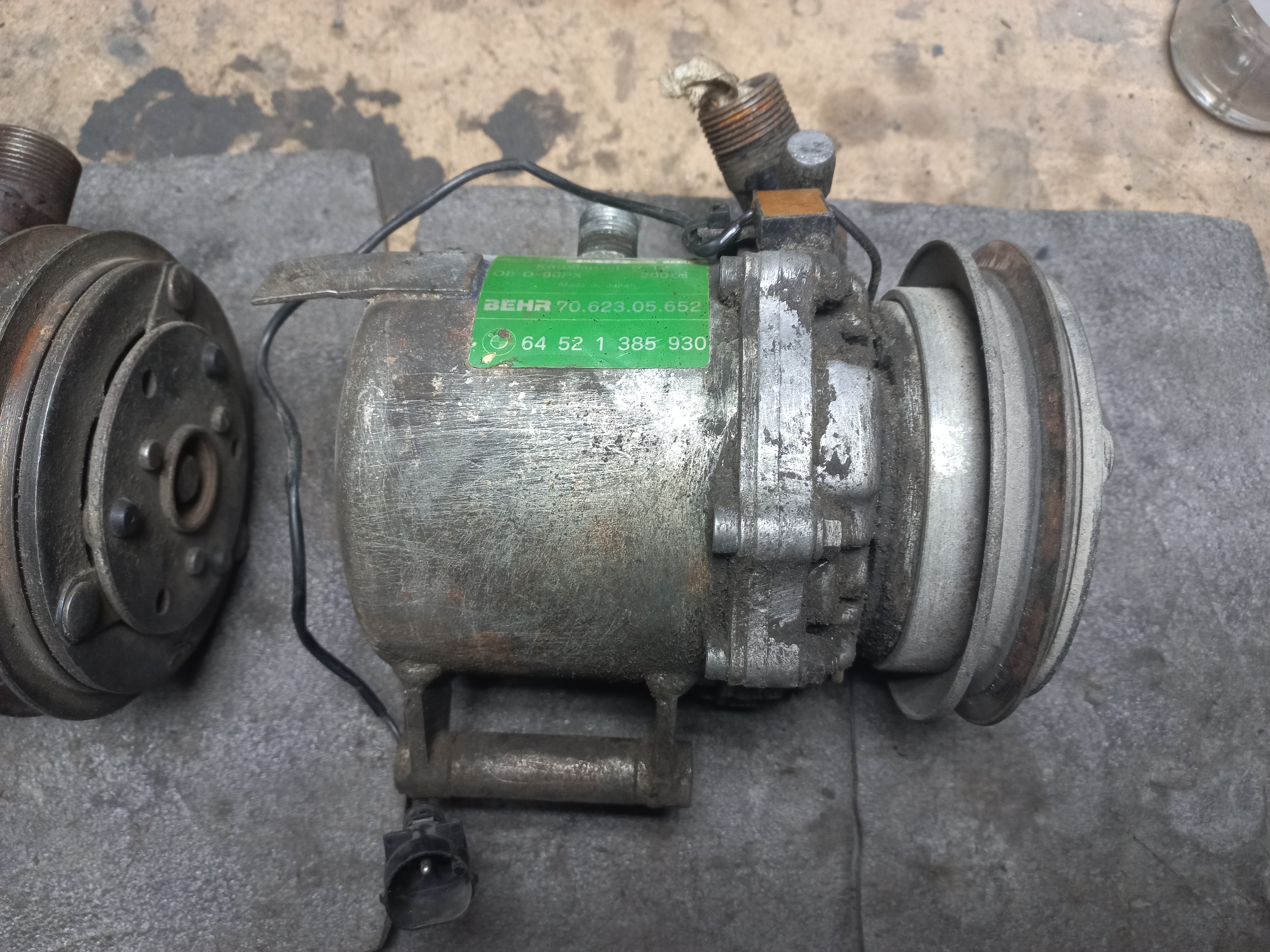
The second.

The third.

The first one that was purchased in the air conditioner kit is a BOSCH BEHR compressor for R12 freon. Apparently this is an earlier version, without an oil temperature sensor on the compressor housing and with a 1-pin connector.

Although, judging by the ETM wiring diagrams, it is the opposite - early compressors were with this sensor, and later ones without it. It is not very clear, but in fact later compressors usually, after all, have this sensor.
I have already told the sad story of the previous owners about installing this compressor with a mount for the M20 motor on the M42 motor, using a homemade "adapter". I don't know what was the reason - this "adapter", or maybe some kind of accident, but the compressor was thrown out, along with parts of its housing.

Over the years, everything there has rusted to death. Of course, it's junk.
Therefore, I immediately bought another compressor - SEIKO. And even started to disassemble it a little.

But from the remnants of the text on the stickers, I realized that it is for freon R134a. Moreover, it was all wet and covered in grease with a green fluorescent dye - that is, it was definitely leaking, and quite a lot. It definitely needs repair.
So I bought a third compressor - again BOSCH BEHR for R12 freon, but a little newer, removed from a BMW E34. It already has a compressor oil temperature sensor and a 3-pin connector installed.

The difference between the first and third compressors is precisely the presence of this sensor and its wiring. The first still has a valve on the inlet fitting for pumping, while the third does not. Structurally, they are identical.

So, I will install the third one.
I have never dealt with these compressors before, so I started looking for information on the Internet. I read that very often a lot of dirt collects in the compressor, which can get into the entire system after it is started. Since my entire system is clean and assembled from scratch, I really would not like this! So, I decided to disassemble and clean the compressor before installation, just in case. I turned to specially trained specialists. ) But all of them, having heard about the 40-year-old compressor for the BMW E30, which had been lying idle for many years, advised me to throw it away and find a new one ))) And when I told them about R12 freon, they almost didn't send me! )))
Therefore, as always - if you want to do something well - do it yourself! )
I started looking for information on repairing such compressors. I only found some articles with randomly placed photos, but practically no text explanations. I don't understand why I make such "reports" if they are of no practical use to anyone... Well, that's it.... That's why I always write in great detail! Maybe sometimes, even too much... ;)
So, not finding anything, I decided to "practice" on my first broken compressor. After all, it won't get any worse from this! ))
Since it was just a "practice", I will write the same stupid "report" as I found on the Internet! )) Just photos and a minimum of text.
A normal report will be when disassembling a working compressor.
So, let's start with the simplest thing - remove the inlet fitting and unscrew the electromagnetic coupling diode.


There's a check valve inside - it's a complete mess! )


We unscrew 8 nuts, but the cover doesn't come off. Inside you can also see a whole trash...

You need to unscrew 4 more bolts. To do this, you first need to remove the pulley and the clutch.

The bolt on the pulley unscrewed easily. At first I thought that the pulley unscrews along the internal thread. It turned out that it doesn't. In general, it is not clear why that thread is there. By trial and error, it turned out that the pulley simply comes off upwards. But no pullers will help - there is nothing to catch and rest against. So I removed it this way - carefully driving a screwdriver in a circle between the pulley and the pressure plate.
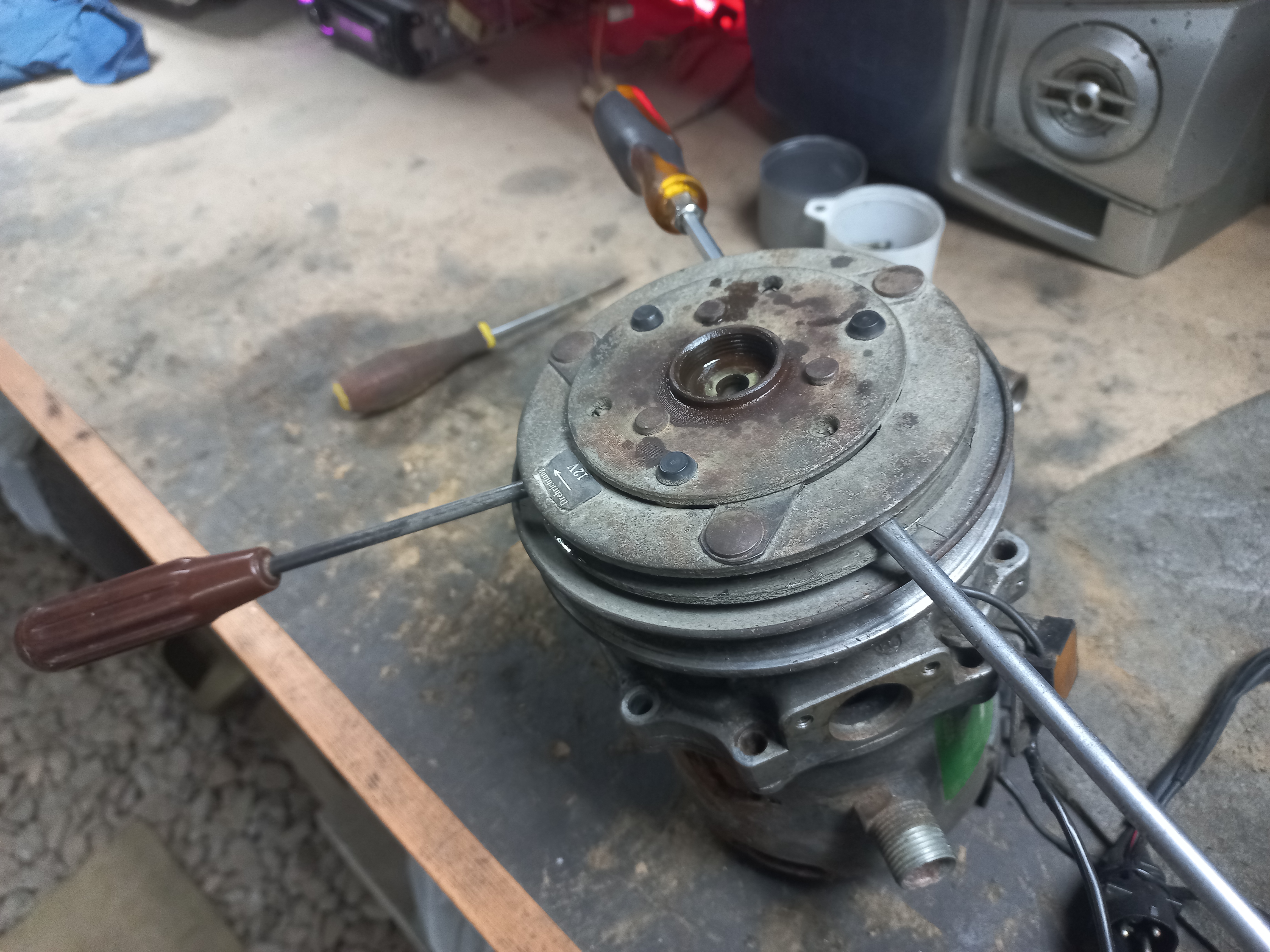
And it worked.

 Unscrew the nut and remove the pulley. It's easy.


Unscrew and remove the electromagnetic clutch with the wiring.


Now you can unscrew the 4 bolts.

But they are VERY tight! So the disassembly stopped for a while...


These bolts were unscrewed only with an impact wrench.

We remove the cover and see this picture! )) In this case, the experts were 100% right )) Although, it was obvious... ) But here the whole point is in "training" ))

We knock out the key and remove the gland with seals.


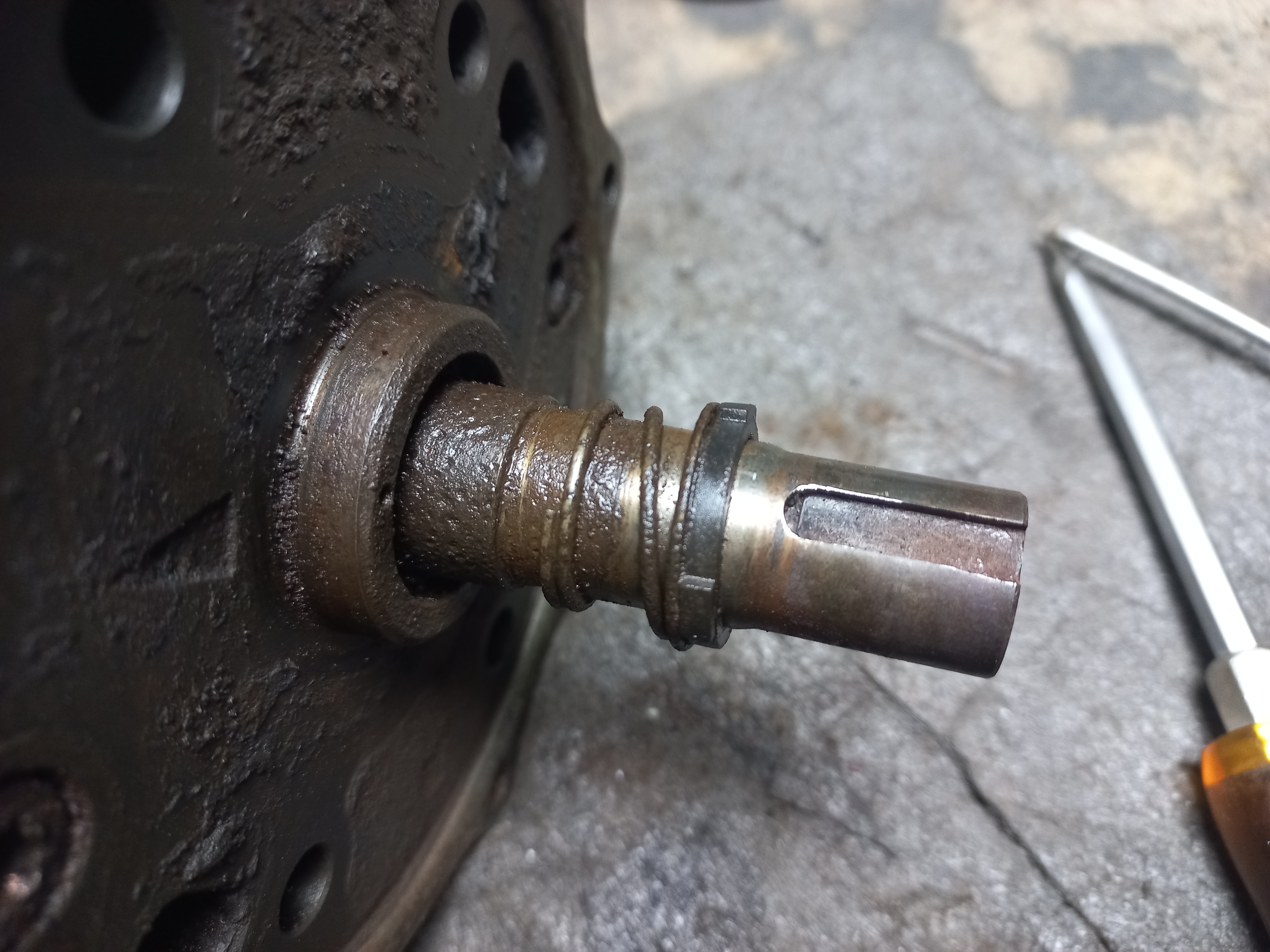

Remove the remaining sealant from the lid.

Remove the sleeve from the cover.


There is also a seal in it.

This concludes the "training".

Further disassembly is possible, except with the help of a "grinder"! ))


But that doesn't make sense anymore.
Especially since I still found normal reports on the repair of such a compressor on old American forums.
Next time I will disassemble a working compressor.Comment
-
Interesting chemical experiments - metal blueing
I'm getting ready to assemble the air conditioner compressor - I sent the housing and small parts and bolts to electroplating for zinc plating, bought a repair kit for seals, ordered new stickers.
When disassembling the compressors, I noticed that the inlet flange had some kind of factory black coating. Or rather, its remains. So I decided to try to restore it.
At the same time, I'll conduct interesting chemical experiments! ;) I've already written about my attempts to copper-plate metal in garage conditions, but the results were not satisfactory.
So, the next experiment is chemical (cold) blueing of metal. For this, I bought such a kit - a special liquid 100 ml, an abrasive for surface preparation and instructions.


I decided to experiment on the compressor flange. The factory coating on its lower part was completely preserved, so I decided not to remove it and covered it with masking tape. Since I was not sure of the results...
I sanded the upper part, washed it thoroughly and blew it with air. It seems that everything is ready for the experiment.

But the instructions are for fools! )) I just took it and treated the flange with liquid in two layers - it immediately became a beautiful dark black color. Well, great, right! ) I left it to dry, and when I came to evaluate the result, I was, to put it mildly, confused!... ))) It was simply completely rusted! )))


Not at all the result I was hoping for.... ) It resembles the result of copper plating, but even worse )))
I contacted the seller, who explained to me how to do everything correctly. Although, it was enough to just carefully read the instructions first! )
So, the second attempt.
The parts must be thoroughly cleaned of rust, dirt, dust, and degreased with a solvent.
For quick drying, I used paper towels and an industrial fan heater. Motor oil is used to preserve the coating.

This time I have already taken both inlet flanges from both compressors. I started with the flange from the broken compressor.
We treat it with liquid using a brush, remove the remaining liquid by blotting with a paper towel, and let it stand for no more than 1 minute. After that, we apply a second layer, and let it stand for no more than 1 minute. We thoroughly rinse the part under running water. We quickly wipe it dry with napkins and dry it with a fan heater.

We treat the part with motor oil to preserve the coating. We wipe off the remaining oil with paper towels. We wipe with a soft cloth. As a result, we get a beautiful matte black coating.

I repeat the same process for the working compressor flange.
The first layer after drying, no more than 1 minute.

The second layer after washing and drying, no more than 1 minute.

Preservation with motor oil.

The finished result after wiping off the oil.

Beautiful matte black finish.

The second attempt was even more successful! )


In my opinion, it looks pretty good, but we'll see how long it lasts...
P.S.
It's important to do exactly as the instructions say! Do everything quickly! Otherwise, if you leave it for too long, or don't rinse it well, or don't preserve it, the part will rust completely very quickly, right before your eyes!
P.P.S.
I restored the wheel bolts on my E53 in the same way.
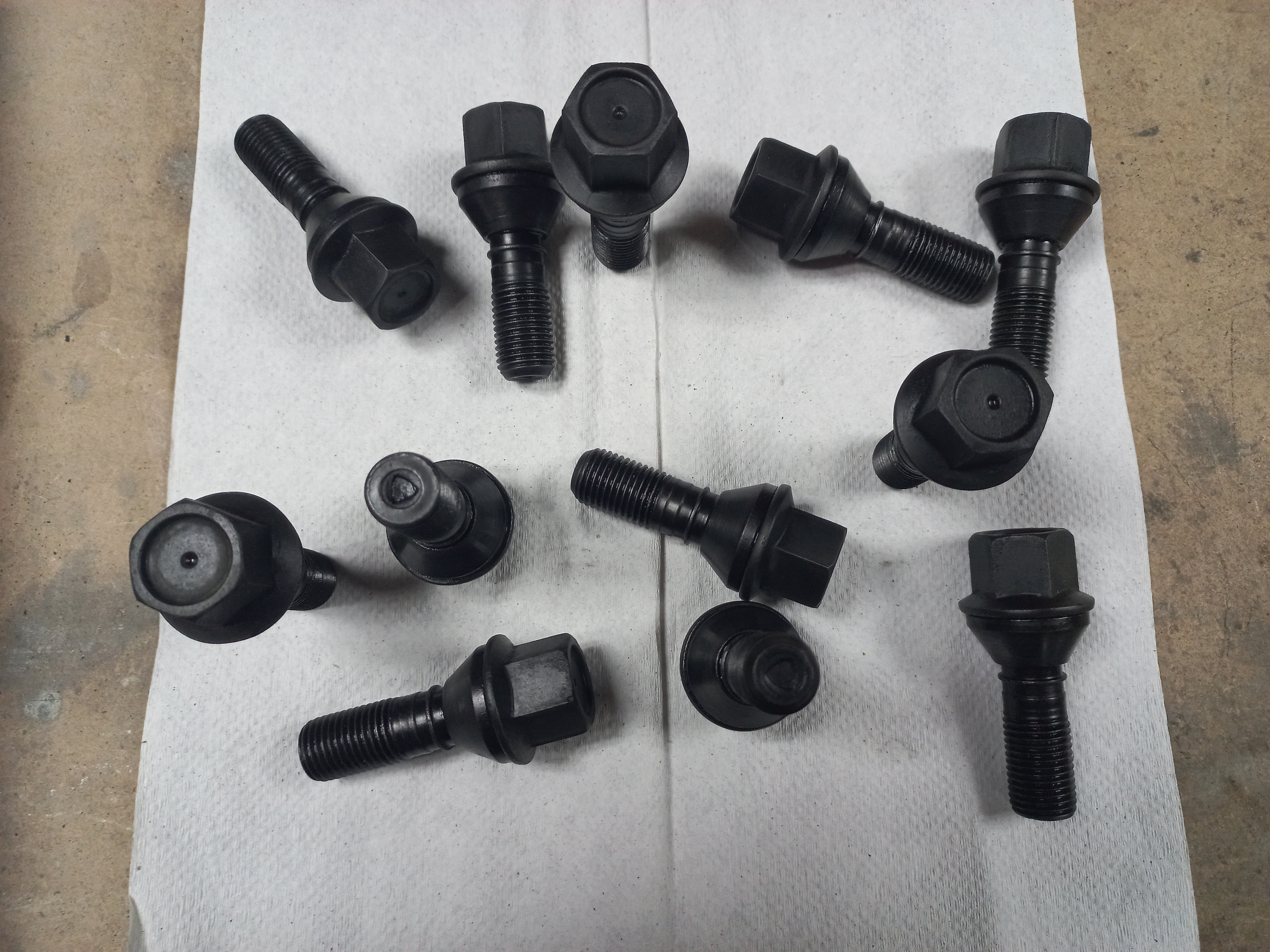

I think that in this case, it will become clear how reliable this coating is!
It's been holding up for a week! ;)Comment

Comment